
Exploring the Stanford University’s A.I. Index Report 2021
A brief analysis of the Stanford University’s Artificial Intelligence Index Report 2021


At the beginning of March 2021, the fourth edition of the A.I. Index 2021 Annual Report, a comprehensive yearly analysis of the major transformations happening in artificial intelligence, was released by the Stanford University’s Human-Centered Artificial Intelligence Institute (HAI).
This year, Standford University dramatically increased the amount of data available in the study, partnered with a broader range of external organizations to calibrate our data. It deepened relations with Stanford’s Institute for Human-Centered Artificial Intelligence (HAI).
The A.I. Index Report monitors, distills, and visualizes data related to artificial intelligence, offering impartial, rigorously vetted, and internationally sourced data for policymakers, academics, executives, journalists, and the general public to gain insights into the complex field of A.I.
The report points to be the world’s most credible and authoritative source for data and insights about A.I.
The report authors include Daniel Zhang, Saurabh Mishra, Erik Brynjolfsson, John Etchemendy, Deep Ganguli, Barbara Grosz, Terah Lyons, James Manyika, Juan Carlos Niebles, Michael Sellitto, Yoav Shoham, Jack Clark, and Raymond Perrault.
We can see in the report that the top three industries with the highest A.I. adoption in 2020 were high-tech and telecommunications, automotive and assembly, and financial services, respectively, and the Top 3 countries with the highest A.I. skill penetration are India, U.S., and China, respectively.
The report points out also the ethical challenges of A.I. applications, exploring how A.I. transparency, explainability, accountability, and privacy are frequent themes in constructing ethical guidelines and frameworks.
Conclusion
We live in extraordinary times, and the Advances in artificial intelligence (A.I.) machine learning is revolutionizing all industries across the world. It is rapidly transforming science, education, and technology now and in the not-so-distant future ahead.
Top Takeaways from the A.I. report 2021
A.I.’s investment in drug design and discovery grew significantly: “Drugs, Cancer, Molecular, Drug Discovery” earned the highest amount of private AI investment in 2020, more than USD 13.8 billion, 4.5 times higher than in 2019.
The industry’s change continues: In 2019, 65 percent of North American PhDs in A.I. joined the industry — up from 44.4 percent in 2010 — highlighting the increased role that industry has begun to play in A.I. growth.
Generative everything: A.I. systems are now capable of writing text, audio, and images to a sufficiently high level that humans have a hard time knowing the difference between synthetic and non-synthetic outputs for specific restricted technology applications.
A.I. has a diversity challenge: by 2019, 45 percent of new U.S. resident A.I. Ph.D. graduates were white — by comparison, 2.4 percent were African American, and 3.2 percent were Hispanic.
China overtakes the U.S. in A.I. newspaper citations: since surpassing the United States in the total number of journal publications a few years ago, China now also leads newspaper citations; however, the United States has consistently (and significantly) more A.I. conference papers (which are also more frequently cited) than China in the last decade.
Most US AI Ph.D. graduates come from abroad — and remain in the U.S.: The number of international students among new A.I. PhDs in North America continued to grow to 64.3 percent in 2019 — a 4.3 percent increase from 2018. Among international graduates, 81.8 percent remained in the United States, and 8.6 percent worked outside the United States.
Surveillance technology is fast, cheap, and increasingly ubiquitous: The technologies needed for large-scale surveillance are rapidly maturing, with image classification techniques, facial recognition, video processing, and voice identification all making substantial progress in 2020.
There is a lack of benchmarks and consensus on A.I. ethics: While several groups generate a variety of qualitative or normative outputs in A.I. ethics, the field typically lacks metrics that can be used to quantify or evaluate the relationship between more comprehensive social discussions on A.I. ethics.
Technology advancement and technology development itself. Also, researchers and civil society consider A.I. ethics as more critical than industrial organizations.
A.I. has attracted U.S. Congress’s attention: the 116th Congress is the most AI-focused Congressional session in history. The number of A.I. references in the Congressional record more than triple that of the 115th Congress.
References
- A.I. Index 2021 | Stanford HAI. https://hai.stanford.edu/ai-index-2021
- Bumps along the road towards a technological revolution …. https://www.man.com/maninstitute/bumps-along-the-road-towards-a-technological-revolution
About the Creator
Jair Ribeiro
A passionate and enthusiastic Artificial Intelligence Evangelist who writes about people's experiences with technology and innovation.
Keep reading
More stories from Jair Ribeiro and writers in 01 and other communities.
Can we explain AI? An Introduction to Explainable Artificial Intelligence.
A few years ago, when I was still working for IBM, I managed an AI project for a bank. During the final phase, my team and I went to the steering committee to present the results. Proud as the project leader, I have shown that the model has achieved 98 percent accuracy in detecting fraudulent transactions. Everything went well until one of the executives asked:
By Jair Ribeiro5 years ago in 01
The Role of AI and Automation in Legacy Modernization
In today’s rapidly evolving digital landscape, enterprises cannot afford to operate on outdated technologies. Legacy systems, once the backbone of enterprise IT—are now a major obstacle to growth, innovation, and scalability. The rise of Digital Transformation Service offerings has shifted attention toward more agile, efficient, and intelligent software ecosystems.
By keith laurancea day ago in 01
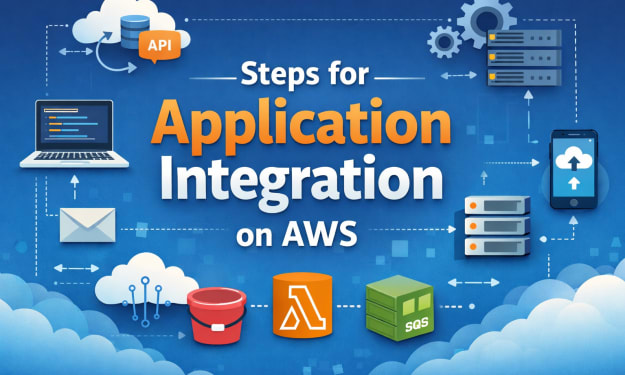
Steps for Application Integration on AWS
It is neither new nor a secret that modern businesses have come to rely on a massive ecosystem of microservices and third-party SaaS platforms. But to do what exactly, you ask. For starters, to provide seamless digital experiences. Adopting distributed architecture decidedly improves agility and scalability. But there's also a significant challenge, i.e. ensuring independent components can communicate and share data without forming brittle dependencies. Thankfully, an effective solution is found in application integration on AWS. It addresses this issue by providing a managed framework for connecting disparate systems. Organizations can automate business processes while reducing the need for custom "glue" code by using purpose-built services for messaging, workflow orchestration, etc.
By Ryan Williamsona day ago in 01



Comments
There are no comments for this story
Be the first to respond and start the conversation.