
Entangling Trap of Modern Phones
Why It is so Addicting


The pervasive use of smartphones is a phenomenon that affects a significant portion of the global population, with over 2.5 billion individuals owning such devices. Unfortunately, many individuals struggle with the compulsion to constantly check their phones. In response to this issue, a new application has been developed to address phone addiction. The problem of addiction is a lucrative one, and it appears that our society may be comprised of smartphone addicts. This is due in part to the fact that these devices are designed to maintain our attention, and are intentionally addictive. However, by becoming aware of the tactics employed to capture our focus, it is possible to cultivate a healthier relationship with our phones. It is my belief that we are living in a world that resembles the Truman Show, where everything is orchestrated to entertain or engage us, without our conscious awareness.
Tristan Harris, formerly Google's design ethicist, currently leads a nonprofit initiative known as Time Well Spent, which advocates for the awareness of how technology companies profit from users' attention. According to Harris, technology is not designed to assist us, but rather to keep us engaged. In an effort to address this issue, I presented Harris with my phone and inquired about potential solutions. His recommendation was to disable all notifications, except for those from actual human contacts. While calls, texts, and messages typically indicate a desire for communication, many apps simulate social interaction to encourage prolonged usage. For instance, Facebook may send a push notification regarding a friend's interest in an event near you, thereby leveraging your desire for social connections to increase app usage. However, notifications did not always function in this manner. When push notifications were first introduced for email on Blackberries in 2003, they were intended to reduce phone usage by allowing users to view incoming emails without repeatedly refreshing their inbox.
In contemporary times, it is possible to receive notifications from any application installed on one's mobile device. Consequently, each time an individual checks their phone, they are presented with a diverse range of notifications that can elicit a wide spectrum of emotions. If the notifications were not random and instead consistently positive or negative, the likelihood of addiction would be reduced. The efficacy of this design is evident in the fact that slot machines generate more revenue in the United States than baseball, movies, and theme parks combined, and they are known to be addictive at a rate three to four times faster than other forms of gambling. Some applications even emulate the sensation of pulling a slot machine lever through the "pull to refresh" feature, which is a deliberate design choice. Although these applications are capable of continuously updating content, the pull action creates an addictive illusion of control over the process.
In the future, it is possible that we will witness the emergence of healthier methods for delivering notifications. According to research, bundling notifications, whereby phones provide a batch of updates at predetermined intervals, can alleviate user stress. However, it is necessary to grayscale the screen to reduce the impact of color on the user's attention. Warm colors are particularly sensitive to the human eye, as demonstrated in eye-tracking tests, where bright red hues are particularly attractive. Consequently, many apps have redesigned their icons to be brighter, bolder, and warmer over time, and notification bubbles are often red. Nevertheless, the distracting effect of color can be neutralized by selecting a greyscale color filter in the phone's accessibility settings. By rendering everything in black and white, the brain is not deceived into believing that one notification is more important than another. The reason why slot machines are designed with bright colors, flashing lights, and sound effects is to provide sensory input that enhances their addictiveness. Therefore, removing color can reduce the addictiveness of such devices.
In conclusion, it is advisable to limit the contents of your home screen to essential tools that are required for daily use. It is recommended that upon unlocking your home screen, only in-the-moment tools that facilitate your daily routine should be visible. For instance, applications such as Maps, Calendar, and other navigation tools that aid in getting to a destination should be prioritized. It is crucial to avoid applications that may lead to endless scrolling, as they tend to create a sense of loss of control and make it difficult to disengage. Therefore, it is essential to filter out such applications and prioritize those that enhance productivity and efficiency.
According to research, individuals tend to rely more on visual cues rather than internal cues to cease consumption. A study conducted in 2005 revealed that individuals who consumed soup from a self-refilling bowl consumed 73% more than those who consumed soup from a normal bowl filled by servers. However, those who consumed soup from the self-refilling bowl did not experience a greater sense of satisfaction. Therefore, a visual cue, such as an endpoint, is more effective in indicating the appropriate time to stop consumption than one's own sense of satisfaction. As many applications lack an endpoint, it is necessary to structure one's home screen in anticipation of potential distractions.
We frequently engage with our mobile devices, a behavior that is often underestimated by the majority of individuals. However, it is possible that the appearance of technology may not always remain the same. There are proposals for alternative interfaces that offer practical options and are more transparent in terms of the amount of time that will be expended on a particular action compared to another. Nevertheless, the question of what truly deserves one's attention on an interruptive basis is a profound philosophical inquiry. It is uncertain whether individuals possess the ability to answer this question. It is a challenging query that is not typically contemplated. Nonetheless, it is a question that necessitates consideration by all individuals at present.
About the Creator
Hanif Salahudin
Truth and Knowledge are worth sharing. Please enjoy reading my content.
Keep reading
More stories from Hanif Salahudin and writers in 01 and other communities.
Flawed Designed World
FLAWED DESIGNED WORLD In 1989, the Shinkansen Bullet Train of Japan encountered a predicament. Despite its remarkable speed, clocking in at approximately 170 miles per hour, it produced a deafening noise upon exiting tunnels. This noise emanated from various sources, but the train's rapid entry into tunnels caused atmospheric pressure waves to surge through the opposite end. Consequently, the air exiting the tunnels created a sonic boom that could be heard up to 400 meters away.
By Hanif Salahudin3 years ago in Earth
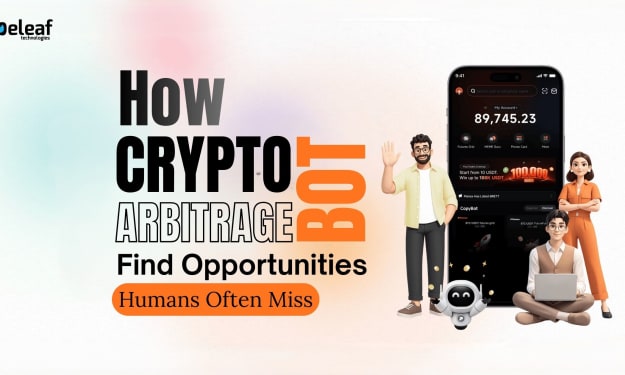
How Crypto Arbitrage Bots Find Opportunities Humans Often Miss
The cryptocurrency market operates 24 hours a day, seven days a week, across hundreds of trading platforms around the world. Unlike traditional financial markets that follow fixed trading hours, crypto markets are constantly active, creating continuous fluctuations in asset prices. Because different exchanges operate independently, the same cryptocurrency can sometimes be priced slightly differently across platforms. These price differences create opportunities for a trading strategy known as arbitrage.
By smithtaylor5 days ago in 01
The Man Who Never Appeared on the Camera
Every small community has its own collection of stories that people whisper about late at night, stories that some claim are real while others insist are nothing more than exaggerated rumors passed down through generations, and in the quiet town of Brookdale there was one particular story that had survived for nearly thirty years because no one could ever fully prove whether it was true or simply a strange coincidence that had grown into a legend.
By The Curious Writerabout 14 hours ago in 01
My First Time Skiing and I Got Lost, Alone, in the French Alps
Looking back, I can trace some of my life’s biggest adventures to a simple action from my sister. She’d introduced me to Tommy (a very long time ago), a colleague of hers, who had overshared his penchant for Italian-looking women, and I ticked that box.
By Chantal Christie Weissa day ago in Humans



Comments
There are no comments for this story
Be the first to respond and start the conversation.