
Electronic chip technology: The amazing future
The Evolution of Electronic Chip Technology
Invention of the Transistor
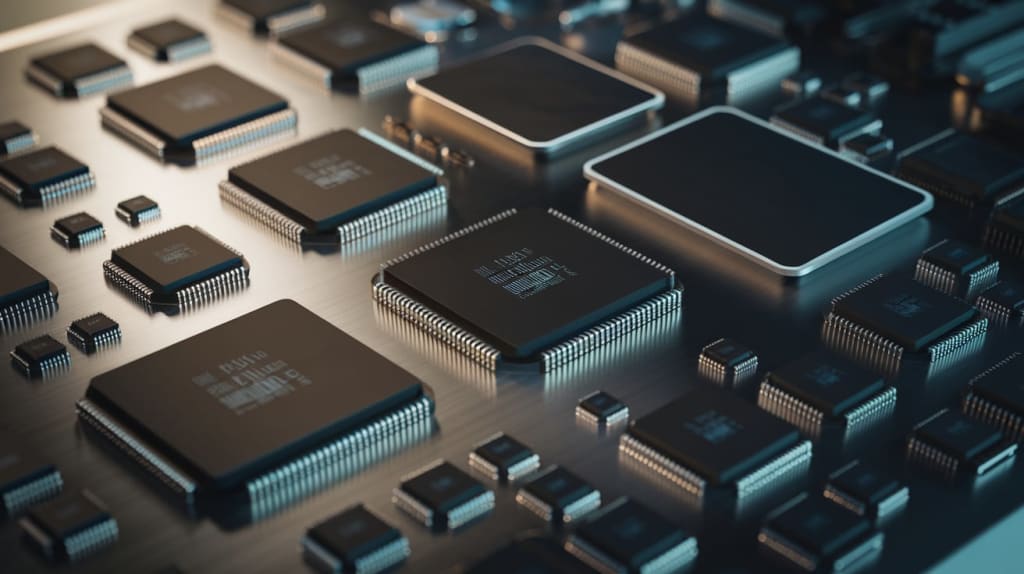
The journey of electronic chip technology began with the invention of the transistor in 1947 by John Bardeen, Walter Brattain, and William Shockley at Bell Labs. This breakthrough replaced vacuum tubes, offering a smaller, more energy-efficient, and reliable component essential for amplifiers and switches. The transistor set the stage for subsequent advancements in electronic circuitry.
Introduction of Integrated Circuits
Integrated circuits (ICs), conceived by Jack Kilby at Texas Instruments and Robert Noyce at Fairchild Semiconductor around 1958-1959, revolutionized electronic design by combining multiple transistors onto a single chip. This miniaturization enabled more complex functionalities in a compact form, drastically reducing size and cost while improving performance and reliability.
Advancements in Semiconductor Materials
Early semiconductor materials, primarily germanium, were soon supplemented and then largely replaced by silicon. Silicon's superior electronic properties, such as its ability to maintain semiconductor behavior over a wide range of temperatures, and the development of silicon dioxide (SiO2) as an effective insulator, made it the material of choice. This shift was crucial in the mass production of reliable and efficient chips.
The Impact of Moore's Law
Predicting the Number of Transistors
Gordon Moore, co-founder of Intel, in his 1965 paper, observed that the number of transistors on a chip doubled approximately every two years, leading to what is now known as Moore's Law. This empirical prediction highlighted the exponential growth in computing power, guiding the semiconductor industry's expectations and roadmaps for future advancements.
Influence on Design and Manufacturing
Moore's Law significantly influenced how electronic chips were designed and manufactured. As transistor counts soared, design optimization and manufacturing precision became critical. This led to innovations in computer-aided design (CAD) tools, semiconductor fabrication techniques, and error detection methods to maintain quality.
Challenges in Upholding Moore's Law
Despite its historical accuracy, Moore's Law faces significant challenges as transistors near atomic scales, causing issues such as quantum tunneling and heat dissipation. The physical limitations of miniaturization push the industry to explore alternative materials, new transistor architectures, and unconventional computing paradigms to sustain growth.
Key Innovations in Chip Architecture
Development of Microprocessors
The microprocessor, introduced in the early 1970s, was a pivotal innovation. The Intel 4004, for instance, integrated the functions of a CPU onto a single chip, enabling computers to become more compact and affordable. It spearheaded the development of personal computing by drastically improving processing capabilities within a smaller footprint.
Evolution to Multi-Core Processors
As single-core processors reached their performance limits due to heat and power constraints, the industry transitioned to multi-core processors. By placing multiple cores on a single chip, computational tasks could be parallelized, enhancing performance and efficiency in handling complex workloads and multitasking.
Emergence of System-on-Chip (SoC)
The System-on-Chip (SoC) represents another leap in chip architecture, integrating all necessary components—CPU, GPU, memory, and more—onto a single chip. SoCs power a wide range of devices, from smartphones to embedded systems, by providing comprehensive, energy-efficient solutions that optimize performance and functionality.
Advances in Fabrication and Miniaturization
Photolithography Techniques
Photolithography, the process of using light to pattern semiconductor materials, has been the cornerstone of chip fabrication. Innovations in this technique, such as deep ultraviolet (DUV) and extreme ultraviolet (EUV) lithography, have enabled the creation of finer patterns, allowing for more transistors in a given area and thus increased chip performance.
Progress in Nanotechnology
Nanotechnology has opened new frontiers in chip fabrication. Techniques like atomic layer deposition (ALD) and nanoprinting have allowed for unprecedented precision in material placement at the nanoscale, resulting in more efficient transistors and circuits. This advancement supports the continued miniaturization of electronic components.
3D Chip Stacking and Packaging
3D chip stacking and advanced packaging technologies have emerged as solutions to overcome the limitations of traditional planar designs. By vertically integrating multiple layers of chips, these techniques improve data transfer speeds and reduce latencies while conserving space and enhancing overall performance.
Applications and Global Impact
Usage in Consumer Electronics
Electronic chip technology is ubiquitous in consumer electronics, driving the functionality of smartphones, tablets, and wearable devices. These chips enable powerful computing capabilities, multimedia processing, and connectivity, significantly shaping modern lifestyles and consumer behaviors.
Contribution to Telecommunications
In telecommunications, chips facilitate everything from base stations to user devices. The rapid advancements in wireless technology, including 5G networks, are heavily reliant on sophisticated chips that handle complex signal processing, data transmission, and reception, thus revolutionizing global communication infrastructures.
Role in Computing and Data Centers
Chips are the backbone of computing and data center operations, powering servers, storage solutions, and networking equipment. They support vast computational tasks, enable efficient data processing and management, and are critical for the functioning of the internet, cloud services, and big data analytics.
Future Trends in Electronic Chip Technology
Potential of Quantum Computing
Quantum computing represents a paradigm shift with the potential to surpass classical computing's limitations. By leveraging quantum bits (qubits) and principles of quantum mechanics, quantum chips could perform complex calculations at unprecedented speeds, solving problems currently beyond the reach of conventional computers.
Rise of Artificial Intelligence Chips
The emergence of artificial intelligence (AI) and machine learning has driven the development of specialized AI chips. These chips, optimized for parallel processing and executing neural network computations, are crucial for advancing AI applications, from autonomous vehicles to sophisticated data analytics and decision-making systems.
Environmental and Economic Considerations
As chip technology advances, environmental and economic considerations become increasingly important. Sustainable manufacturing practices, efficient energy usage, and recycling programs for electronic waste are essential to mitigate the environmental impact. Economically, the industry faces challenges in balancing innovation with cost, accessibility, and ethical practices.
Through continual innovation, electronic chip technology fundamentally transforms various domains, driving progress and connectivity in the modern world.
About the Creator
Reader insights
Outstanding
Excellent work. Looking forward to reading more!
Top insight
Eye opening
Niche topic & fresh perspectives
Keep reading
More stories from Wajd Mohamed and writers in 01 and other communities.
Encrypted digital currencies
Increased Adoption and Mainstream Usage Digital currencies have transitioned from niche technological novelties to a burgeoning mainstream financial instrument. Bitcoin, Ethereum, and other cryptocurrencies are increasingly utilized for everyday transactions, investments, and even cross-border payments. Astute market leaders, including Tesla and Paypal, have exposed cryptocurrency to a broader audience by accepting digital currencies as legitimate forms of payment. As more consumers and businesses adopt these digital currencies, the traditional financial landscape continues to evolve, paving the way for a decentralized monetary system.
By Wajd Mohamedabout a year ago in 01
Why Insurance APIs Are a Soft Target for Fraudsters
Introduction – Why Insurance APIs Attract Fraud at Scale Insurance platforms have undergone a rapid digital transformation. Policy purchases, endorsements, claims submissions, renewals, and payouts are now handled almost entirely through APIs rather than traditional user interfaces. This shift has improved speed and scalability, but it has also quietly introduced a new class of risk.
By Sam Bishop2 days ago in 01
What Working With Expert SEO Services Taught Me About Local SEO?
The first warning sign didn’t show up in rankings. It showed up in a conversation. A sales lead leaned into my doorway and said, almost apologetically, “Traffic looks good, but the calls don’t feel any different.” There was no accusation in his voice—just confusion. And that made it harder to dismiss.
By Jane Smith2 days ago in 01
The Devil's Triangle
The sails ruffled in the breeze as we cruised along. The Sea Breeze was a mid-size catamaran that sailed out of Royal Naval Dockyard in Bermuda. We had booked this trip weeks in advance and were now looking at our Captain, Spike and two boat hands. Paddy and Wilson seemed like nice guys, joking around with the passengers and telling us some stories about Bermuda that only locals would know. Their island accents sounded almost British but they were pleasant to listen to.
By Barbara Gode Wilesabout 21 hours ago in Fiction


Comments (1)
Really, it's unique and very useful 👌🏻🙂