
Difference b/w “is” and “==” in Python
Speed up your string comparisons with 'is'


Many programmers and beginners love python. Python is one of the languages that is witnessing incredible growth and popularity year by year.
In 2017, Stack overflow calculated that python would beat all other programming languages by 2020 as it has become the fastest-growing programming language in the world. Python language is one of the most accessible programming languages available because of its Readability, tons of libraries ,Vibrant Community , can be used for Web Programming, Desktop Applications, Big data, Cloud Computing, Machine Learning and so on.
It’s very important for every Pythonista to understand the difference between == (equality operator ) and is ( identity operator ) before you use.
But, many of us are confused about which one to use in which situation. Let’s understand it clearly.
In this article, I will discuss
- What is equality and identity operators
- When to use equality and identity operators
- Which one is best.
1. What is == and is operators

The ‘is’ operator may seem like the same as the == (equality operator) but they are not same. The ‘is’ is an identity operator used to checks whether two variables point to the same object in memory or to compare identity of two objects . It returns True if the operands are identical (refer to the same object).
Let’s see with an example,
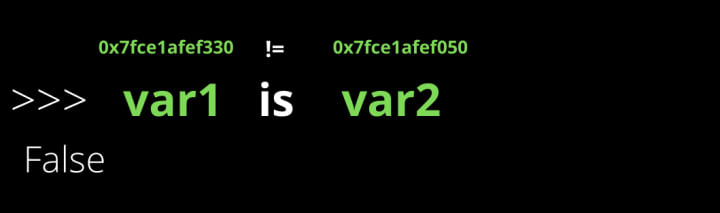
Above code returned False because the two variables pointing to the different objects i.e. different memory addresses (0x7fce1afef330 & 0x7fce1afef050). To get the memory addresses of var1 & var2 use hex(id(var1)) and hex(id(var2)).
On the other hand, the == operator checks if the values for the two variables are the same. It returns True if both operands are equal.

As expected, above code returned True because the contents of the two variables are equal.
2. When to use == and is operators
- As a rule of thumb, Use the == operator when you primary objective is to compare the contents / values of two objects and you don’t care about where they’re stored in memory. Use the is operator only when you want to check whether two variables are pointing to the same memory address.
- When you perform string comparison operation with ‘==’ operator, python compares character by character.

The string(‘Abc’) used in the above example is very small. But what if we have a long string ? Python still compares character by character. Won’t it be a slow process ? Instead of comparing content, we can compare their memory addresses which are just integers. So, comparing integers are far better than comparing two long strings character by character. This is much faster and less CPU utilization than comparing character by character.
NOTE : Python points variables to same memory address when they hold same content. Not all strings are automatically interned in python. But, we can force strings to be interned by using the sys.intern() .
So, Use ‘is’ (identity) operator than ‘==’ (equality) operator to speed up your heavy string comparison operations.
3. Which one is best
This is definitely individual’s choice, but if you talk about speed ‘is’ (identity) beats ‘==’ (equality) operator.
Let’s check with code which one is actually best in terms of speed.
== operator execution time :
import time
def equality_operator(n):
a = ‘Which one is best? identity or equality ?’ * 1000
b = ‘Which one is best? identity or equality ?’ * 1000
for i in range(n):
if a == b :
pass
start = time.perf_counter()
equality_operator(10000000)
end = time.perf_counter()
print('Total time :',end - start)
-------------------------------------
Total time 14.075116038999113
is operator execution time :
import sys
def identity_operator(n):
a = sys.intern(‘Which one is best? identity or equality ?’ * 1000)
b = sys.intern(‘Which one is best? identity or equality ?’ * 1000)
for i in range(n):
if a is b :
pass
# print(True)
start = time.perf_counter()
identity_operator(10000000)
end = time.perf_counter()
print(‘Total time :’,end — start)
-----------------------------------------
Total time : 0.3351166579996061
Above results shows ‘is’ beats ‘==’ operator in execution time.
About the Creator
Keep reading
More stories from writers in 01 and other communities.
Understanding Flexible LED Wall Washers and Wallwasher Lighting
Wallwashing is a well-established architectural lighting technique used to evenly illuminate vertical surfaces such as walls, facades, and large structural elements. The primary goal of wallwasher lighting is to create uniform brightness across a surface, reducing harsh shadows and visual distractions while enhancing the perception of space and texture.
By charliesamuel7 days ago in 01
Jeff Bezos' head-turning then-and-now photos from high schooler to Amazon billionaire
The businessman and entrepreneur has undergone a huge transformation over the years Looking at Jeff Bezos today, with his $252 billion fortune and life of luxury, it's difficult to imagine him as a regular child, let alone as a short-order cook at McDonald's.
By Dena Falken Esq2 days ago in 01
FPS: The Last Flame Challenge Winners
Welcome to our first Winners Announcement of the year and to the final challenge in the Fall Poetry Series. The Last Flame invited writers to sit with endings, using fire as a central image to consider what remains when something burns out: ash, warmth, memory, silence, or the faint promise of what comes next. The strongest pieces treated endings as gradual rather than sudden, allowing them to flicker, dim, and linger.
By Vocal Curation Team7 days ago in Resources
Getting Serious About Comedy (Part I)
If I were asked to remark on my life and the childhood that paved some road leading me to this point, I would have to say something about all the funny people who surrounded me for the last 26,872 days (and counting). Somewhere along that road, I became a big fan of laughter and the comedy that spawns it – and, I mean not only my own laughter, but the laughter of others, some of which I have actually been responsible for inducing.
By John Oliver Smith5 days ago in Humor


Comments
There are no comments for this story
Be the first to respond and start the conversation.