
Deep Dive into Robo Advisor App Development
Learn how to create and integrate a robo adviser into your financial app, including processes, components, tech stack, expenses, and more.


Traditional wealth management seems outdated in these times of ease, customization, and accessibility. And suddenly, one may fall behind his competitors in this never-ending race. Pros need advanced functionality to support their precise choices; beginners deserve guidance through a sea of new opportunities.
The answer is automation through a robo-advisor. Artificial Intelligence can streamline professional traders' work and simplify that for less seasoned users at the same time. Still, it gets a few more questions. Where exactly is that sweet spot-you want your application user-friendly, simple, yet substantial and advanced enough for smart investment mechanisms? How will you win people's trust when they are generally cautious around automated systems that control people's money?
We'll go deep into the very basics of robo-advisor app development, answering the challenges you have and giving practical insights to push your project ahead. Whether it is starting from scratch or trying to improve an already existing fintech platform, you will learn tactics on how to defeat obstacles and create a great user experience.
What is a robo-advisor?
It's an app where you manage your investments on autopilot. You do not deal with a live financial advisor, you just tell the tool about your financial goals, risk tolerance, and investing preferences. The software uses AI to create and rebalance your investment portfolio, picking where to put your money.
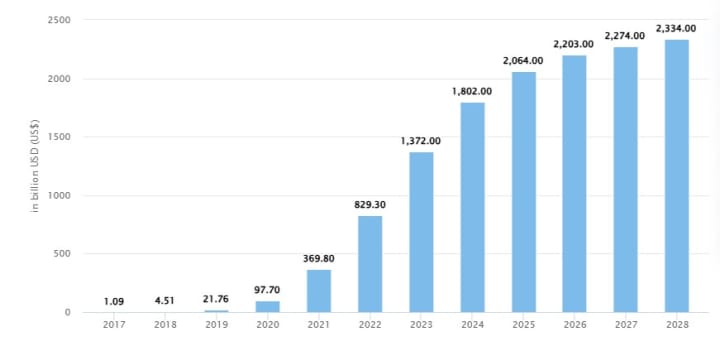
It's an easy-to-use and often lower-cost way to access financial guidance and portfolio management. 34 million people will adopt this in 2028. 6.68% will be the CAGR of assets under management annually. From these statistics, it is clear that traders are attracted to robo investing apps.
Must-have components for a robo advisor app
To make the app work correctly, you need to integrate several important components
A friendly UI built on a strong front end is required. It will be the first thing your users will see, so even a newcomer should be able to manage his account quickly, assess performance, and get into investment opportunities. If people get confused, they will leave. To avoid this, choose a simple layout, provide long onboarding, and include glanceable dashboards.
Smart algorithms help users manage their funds more effectively through automated rebalancing, portfolio management, and other clever ways.
Machine learning models are vastly used in robo investing. They perform predictive analytics and data-driven decision-making to improve investment strategies and risk assessments.
To support front end, create a complete back end system with high-security features: databases that store user information, transaction history, portfolio information, and market data in SQL and NoSQL. Aside from server infrastructure, massive financial data processing systems will be needed, doing analytics and providing insights to users-for example, big data technology.
You'll require cloud infrastructure for scaling up later on. Using cloud services, be it AWS, Azure, or Google Cloud, scale up the hosting, storage, and computing power that may grow when spikes occur with a great influx of users and data.
How to implement this in integrations with financial custodians? Consider using custom-built modules of account management, custody of assets, and transaction settlements to ensure investments are safe and comply with rules and regulations.
Leverage APIs for market data access, transaction execution, and interaction with third-party financial institutions, like investing platforms and banks. Programming interfaces also involve secure techniques for user authentication and session management, including OAuth and JWT. You can provide endpoints for the management of portfolios, which would allow for automated rebalancing and modifications according to investing methods.
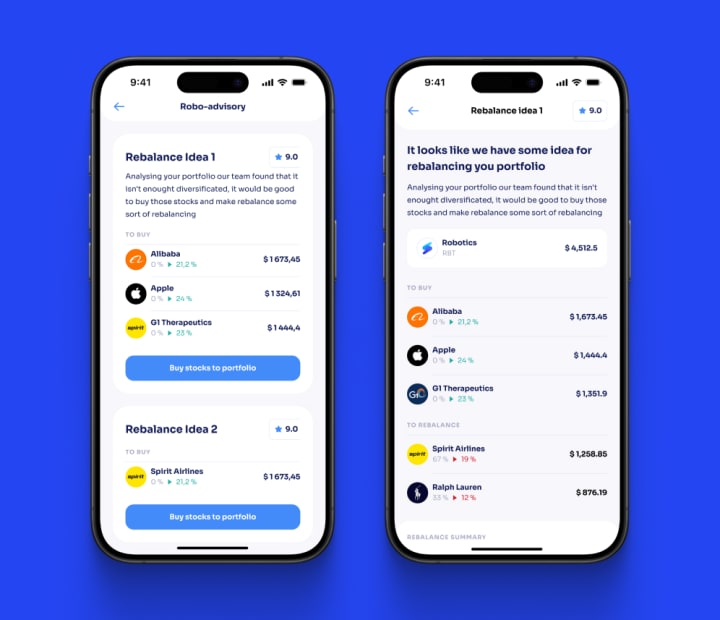
When collaborating with Solio, we focused on young audience with little to no financial experience. So we designed a friendly robo advisor that provides guidance.
Advantages of Having a of a Robo Advisor
If you want to find an uncomplicated but effective way of investing money, this tool is a perfect choice.
- Affordable: They do not charge as much in comparison with human financial advisors; hence, the management of investments is much more accessible.
- Accessibility: You can access it from any location at any time usually via a basic app or website.
- Automation: They handle your investment automatically, even the portfolio rebalance or dividend reinvestment, thereby saving you from the headache.
- Personalization: The tool tailors an investment strategy to your financial goals and risk tolerance with the information provided.
- Diversification: Most robo-advisors usually invest in multiple assets, which helps diversification.
- Transparency: They mostly provide detailed information about the fee, investment, and performance to help you know where your money has gone.
- Tax optimization: Robo-advisors include tax-loss harvesting, which balances your profits and losses to minimize your tax liability.
- No minimum investment: Some apps require little or no minimum investment and are ideal for starters.
How to Develop a Robo-Advisor Application?
It is a very elaborate process that includes much preparation, implementation, and even follow-up. Involve financial specialists and lawyers in the course of the development to produce a successful and compliant product.
Here's a step-by-step strategy for developing an automated investment platform:
Step 1: Research
Study the existing robo-advisors first to outline points of differentiation and competitive advantages. Identify the demographics of your target audience: investment needs, pain issues, etc.
Understand and adhere to the proper financial rules for the market in which you work, such as the SEC, FINRA, and GDPR. If you have any difficulties, you may save time and effort by consulting with legal counsel.
Step 2: Concept Creation
Choose a business plan based on your study (for example, the percentage of assets under management, subscription fees, and so on). Then describe the key features, which include user onboarding, risk assessment questionnaires, portfolio management, performance monitoring, and reporting. Define the algorithms and asset classes that the robo investing software will focus on (for example, ETFs, equities, and bonds).
Step 3: Designing UI
Create user flow diagrams showing how users will move through the software. Based on these diagrams, make the wireframes and prototypes. Remember the visual identity, meaning your design: a logo, colors, and typography. This holistic strategy allows you to focus on simplicity and utility.
Step 4. Tech Stack
Choose the technology stack with your development team. An example follows:
- Create RESTful APIs to handle the communication between front-end and back-end services.
- Database: The decision may fall on either relational-PostgreSQL and MySQL-for data storage, or NoSQL-for example, MongoDB.
- Backend: Select any appropriate framework such as Django, Flask, or Spring and choose a language, Python or Java.
- Frontend: Select frameworks (such as React, Angular, or Vue.js) for creating a responsive UI.
Step 5: Development
Design an interface based on the design, implement investing algorithms and business logic, and integrate with financial data sources and custodians. The back-end API will be used for fetching data and interacting with the users.
Ensure application secure enough: enable encryption (SSL/TLS), safe data storage, and protection of users' data. Perform a compliance audit and check whether the robo advisor app meets all requirements effective in the subject.
Once you've finished a prototype, perform unit tests, integration, and user acceptance tests. In this manner, you have most of your problems from the outset.
Step 7: Scaling
Post-release, set up analytics to monitor user behavior and app performance; use that insight to regularly update features, squash errors, and tune algorithms. Be on the lookout for regulatory changes and keep the app updated accordingly.
Consider adding more features based on the demand of users, such as tax loss harvesting, financial planning tools, or advanced analytics, to help your firm grow. Consider opportunities to enter new markets and change offers based on local laws.
Robo Advisor App Development Costs
Team size, location, and the complexity of the project would significantly affect costs. Let's look at each variable that will make your estimate effective in budgeting.
- The more complicated and advanced the feature, such as AI-driven investment strategies or profound financial analytics, the more it costs to develop.
- With custom UI/UX designs, the price increases, especially when you need to provide an extremely intuitive interactive experience.
- Likely, the prices may considerably depend on hiring a developer from various locations. Development expenses, for instance, may be much higher in North America and Western Europe compared to Eastern Europe or Asia.
- The selection of front-end and back-end technology influences expenses. Some frameworks and tools may require license fees.
A very basic robo-advisor application with limited functionality will cost from $50,000 to $100,000 on average. A more functional advanced app may fall somewhere in the bracket of $100,000 and $250,000, considering an extraordinary custom design. While a fully-featured, very tailored robo-advisor software with advanced algorithms and AI, supplemented by solid security measures, will easily cost above $250,000-maybe up to $500,000.
Remember, maintenance, upgrades, marketing, and customer acquisition costs will demand your attention. If your budget is quite constrained, you could start with an MVP or Minimum Viable Product to test the market; this might reduce your startup expenses while you gather customer feedback.

Is a robo advisor worth it?
Yes, and there are several reasons. Generally speaking, young generations, especially millennials and Generation Z, become increasingly interested in personal finance and investment management. About 45% of people from these categories are worried about their financial situations. They seek more available and affordable opportunities to invest money. Besides this, the fees that robo-counselors have are also cheaper than traditional financial consultants can offer, which attracts such budget clients.
Personalization is a long-term trend. These investment strategies take into consideration the goals of a person, their risk tolerance, and financial condition, raising user engagement and happiness.
Finally, there are collaborations with banks, investment firms, and other fintech companies that can enhance the functionality of the app and attract more users.
While the competition in the field is tough, the potential for innovation, customized services, and meeting the demands of a growing market make this type of app development a very interesting business opportunity.
Designing an online automated investment platform encompasses features, user experience, observance of regulatory issues, and cost control. With a deliberate strategy, qualified specialists, and a response to industry trends, you can make a decent app that will feel the pulse of consumers and be noticed in the sea of competitors.
About the Creator
Shakuro
We are a web and mobile design and development agency. Making websites and apps, creating brand identities, and launching startups.




Comments
There are no comments for this story
Be the first to respond and start the conversation.