
D2C App Strategy for Retail Brands - 2026 Roadmap
A strategic framework for retail leaders to build high-retention direct-to-consumer mobile experiences in a competitive market.

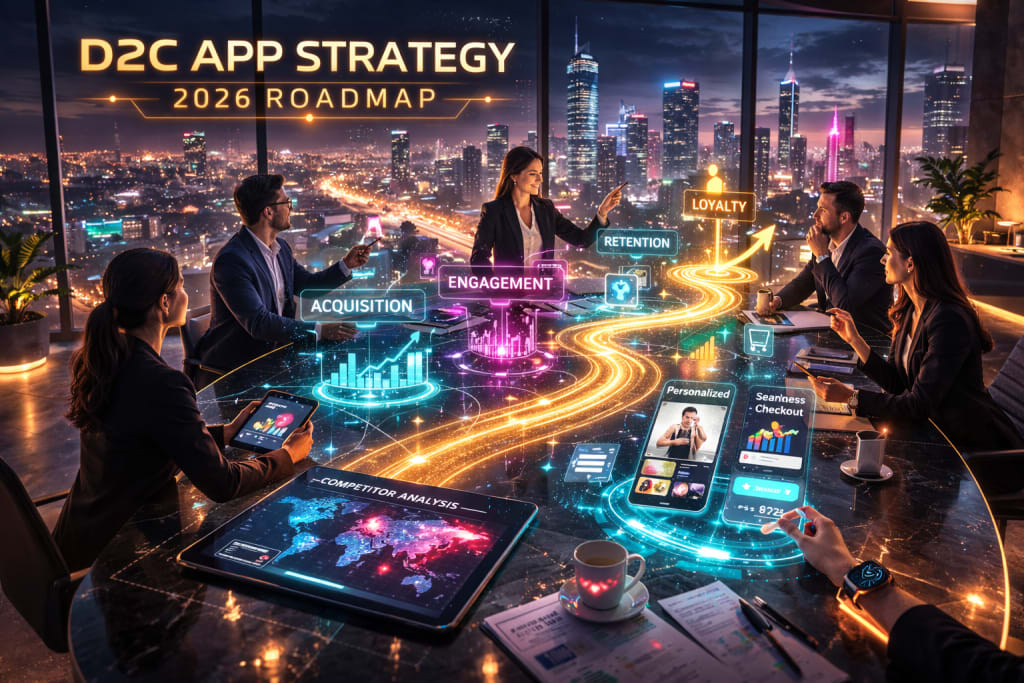
D2C App Strategy for Retail Brands is a specific, systematic plan. Retailers use it to sell directly to consumers. They use mobile applications to do this. This method bypasses third-party marketplaces. It allows brands to own the entire journey. This guide outlines how to implement this strategy. A high-converting plan is essential in 2026. It helps maximize customer lifetime value. It also ensures total ownership of data.
The retail landscape in 2026 is very different. Digital presence alone is no longer enough. Success is defined by deep, direct relationships. The brand must connect straight to the buyer. Third-party data is rapidly diminishing now. This change is due to new privacy regulations. The mobile app is now the primary tool. It is the best way to collect first-party data. It drives personalized commerce for every user. This roadmap is for retail executives. It serves digital strategists as well. The goal is moving past generic web stores. Brands need high-performance, owned ecosystems.
The 2026 D2C Reality: Beyond the Transactional App
A successful strategy must account for platform fatigue. Consumers are tired of too many apps. They are selective about their home screens. Recent research from Gartner supports this fact. In 2025, many retail apps focused only on utility. They just let a user buy a product. These apps suffered very high churn rates. The rates exceeded 60% within 30 days. Retailers now face a dual challenge today. They must provide a very fast checkout. They must also offer non-transactional value. This means giving the user more than products. Users want an experience, not just a store.
Non-transactional value includes several key features. Community features allow users to interact. Augmented reality let users try on items virtually. Predictive replenishment suggests orders before they run out. The app is no longer just a store. It is a service layer for the customer. It follows them from the couch to stores. It creates a bridge between digital and physical.
Core Framework of a 2026 D2C App Strategy
Retail brands must avoid "feature-dumping" tactics. Do not add features without a clear plan. Focus on three main pillars instead. These are Hyper-Personalization, Unified Commerce, and Frictionless Logistics.
1. Identity-Based Hyper-Personalization
Modern apps now use on-device machine learning. This technology tailors the feed in real-time. By 2026, static homepages are completely obsolete. The app interface must adjust for every user. It uses past behavior and current location. It even looks at local weather patterns. Consider a sports apparel brand as an example. The app might highlight rain-resistant gear. It does this when local forecasts predict storms. This makes the app feel smart and helpful.
2. Unified Commerce Integration
Earlier D2C versions made a common mistake. They treated apps as separate silos. They were disconnected from physical stores. In 2026, the app is a remote control. It controls the entire retail experience. "Scan & Go" features are now mandatory. In-store navigation helps users find items. Real-time inventory checking is also vital. Users want to see what is in stock nearby. This is a robust D2C App Strategy for Retail Brands.
3. Frictionless Checkout and Payment
Checkout is a very vulnerable point. It is where most users stop their journey. High-performing apps use biometric authentication now. One-tap "buy now" features are the standard. These features bypass long, boring forms. Businesses often seek regional expertise for this. For example, some look for Mobile App Development in Houston. There is a surge in this regional demand. Retailers want to integrate local fulfillment APIs. They plug these directly into payment gateways. This ensures the app works perfectly everywhere.
Real-World Example: The "Hybrid Retail" Success
Consider a hypothetical brand named "Apex Soles." In early 2026, they changed their model. They moved away from selling on Amazon. They built a dedicated D2C app instead.
- The Strategy: They implemented a new AR feature. Users could "wear" shoes via their camera.
- The Outcome: This led to a 22% reduction in returns. Customers had better expectations of the product.
- The Constraint: They struggled with slow speeds in rural areas. They built a "Lite" version of AR assets. This version triggered on slow network speeds. This solved the problem for all users.
Practical Application
Executing this strategy requires a phased approach. Phases ensure technical stability and adoption.
- Phase 1: The Data Foundation (Months 1-3): Audit your customer data platform (CDP). The app must pull data from CRMs. It must push data to ERP systems. There should be no lag in data flow.
- Phase 2: MVP with a "Hook" (Months 4-6): Launch with a core value proposition. Do not just offer buying options. Include an exclusive loyalty program. Give early access to limited product drops.
- Phase 3: Feedback Loops and Optimization (Months 7+): Use session recording to see user habits. Heatmaps identify where users often drop off. Address technical debt as soon as possible. Maintain a load time under two seconds.
Many brands fail at the final stretch. The purchase funnel is often quite broken. It is a documented reality in retail. Recent data shows 70% of e-commerce apps lose users at checkout. This often happens due to hidden costs. Mandatory account creation also drives users away. A lack of payment methods is another cause. Your strategy must prioritize "checkout hygiene." This is more important than aesthetic features.
AI Tools and Resources
Swiftly Retail AI — A predictive analytics engine.
- Best for: Predicting stockouts and personalizing recommendations.
- Why it matters: It automates the merchandising process. It reduces manual labor for small teams.
- Who should skip it: Small boutiques with very few items. Small data sets make models less accurate.
- 2026 status: Fully operational with new 2.0 API updates. Works for all major e-commerce platforms.
RevenueCat — Subscription and purchase management.
- Best for: Retailers moving toward "Box" subscriptions. It works well for VIP memberships.
- Why it matters: It simplifies complex backend billing rules. It handles mobile receipts and platform rules.
- Who should skip it: Brands only selling one-time physical goods. It is not for brands without recurring components.
- 2026 status: The current industry standard for purchases.
Risks, Trade-offs, and Limitations
A D2C strategy is not a guaranteed win. It carries significant financial and technical overhead. Failure is possible without realistic expectations.
When the D2C Strategy Fails: The "Ghost Town" Scenario
A brand might spend $150k on an app. But they offer no reason to use it. Users open it once and then stop.
- Warning signs: High download numbers occur at the start. Then, daily active users drop by 90%. This drop happens after just one week.
- Why it happens: The brand offered no app-exclusive value. The app was just a website copy. Users delete it to save phone space.
- Alternative approach: Focus on a progressive web app first. Test the market before building native apps.
Hidden Cost Failure: The Maintenance Trap
Many brands budget only for the build. They forget the cost to run it. Operating systems require updates every single year. iOS and Android change their requirements often. If you do not maintain it, it breaks. This leads to many 1-star reviews. Recovery from bad reviews is nearly impossible.
Key Takeaways
- Ownership is Priority: Ownership is the main goal in 2026. Capture first-party data to lower ad costs.
- Friction is the Enemy: Even beautiful apps will eventually fail. Failure happens if checkout takes many taps.
- Value Beyond Sales: Give users a reason to keep the app. Use exclusive content or early access. Include helpful utility-based tools for them.
- Continuous Maintenance: Budget for maintenance every single year. Set aside 20% of the initial cost. This ensures platform compliance and stability.
About the Creator
Keep reading
More stories from Devin Rosario and writers in 01 and other communities.
Why 70% of eCommerce Apps Lose Users at Checkout
The digital retail landscape of 2026 is defined by split-second decisions. Getting a user to download an app is a victory. Getting them to browse products is also a success. However, the data remains startling for most businesses. Nearly 70% of mobile shoppers abandon their journey at the most critical moment. This phenomenon is often called the "Checkout Chasm." It represents billions in lost revenue globally every year.
By Devin Rosarioabout 7 hours ago in 01
How Can I Hack an Instagram Account? Real Techniques Used by Hackers in 2026
The question "How can I hack an Instagram account?" is searched thousands of times daily. While many look for quick shortcuts or paranoia-driven spying tools, the reality of Instagram hacking is far more sophisticated—and dangerous. In 2026, cybercriminals are not relying on magic links; they are exploiting technical vulnerabilities, advanced social engineering, and information-stealing malware.
By Alexander Hoffmannabout 22 hours ago in 01
I wanted to title this something different, but worried that my chosen title might cause problems entering the United States in the future so this is the new title. It's the greatest title. No one has ever written a title better than this. (All titles unrelated to content).
Let me be honest. I am finding this difficult. Now, I like a challenge, a stretch, a bit of an obstacle course. “Write about the decline of the British Empire in the form of a narrative poem in which your protagonist is an artichoke” I read, and flex my fingers. “Write a haiku to evoke the sensation of sibilance using only the first half of the alphabet.” “Well”, I think to myself, “this should be fun.” But “write about a system that isn’t working”? A system that isn’t working? Now? In 2026? ONE system? My favourite system that isn’t working? The sexiest system that isn’t working? The one giving me the most angst day to day? The one giving me the most existential dread? I am, as I say, finding this difficult. I will own that I have contemplated writing a thousand words on why the steady “all on” setting on my fairy lights is the EIGHTH of seven options which must be sequentially activated to get there, because that is a system that some fool came up with and it definitely doesn’t work, and now who is paying the price, eh? But how can I write about my fairy lights when…. When…. When….
By Hannah Moore5 days ago in Humans


Comments
There are no comments for this story
Be the first to respond and start the conversation.