
CDSCO Classifications of medical devices.
CDCSO manages the affairs relating to the classification of medical devices.
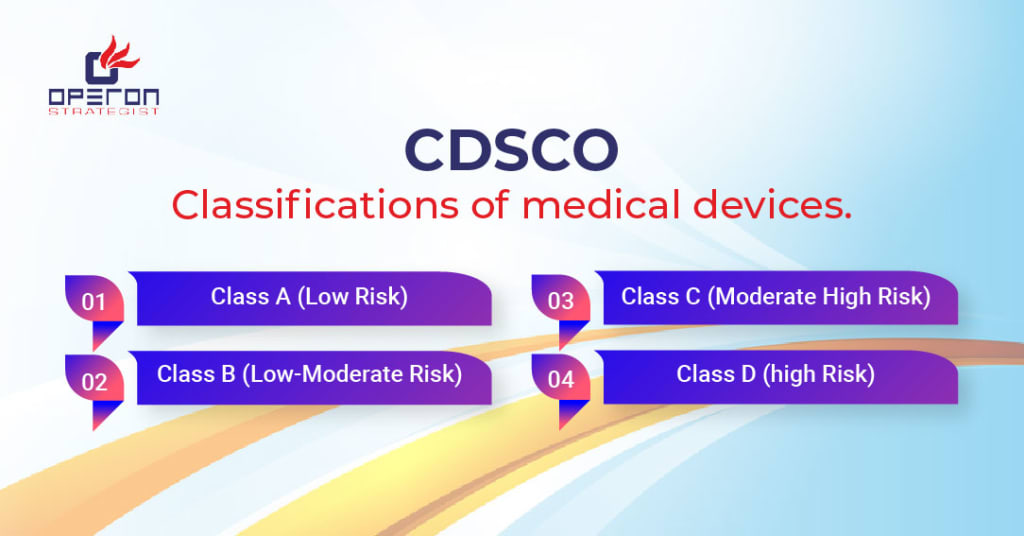
CDCSO manages the affairs relating to the classification of medical devices. CDSCO classifies medical devices into four classes based on risk (A, B, C, and D) as per the regulation, which are as follows
• Class A (Low Risk)
• Class B (Low-Moderate Risk)
• Class C (Moderate High Risk)
• Class D (high Risk)
• Class A (Low Risk) covers Absorbent cotton wools, surgical dressing, alcohol swabs etc.
• Class B (Low-Moderate Risk) covers Thermometer, BP monitoring device, disinfectants etc.
• Class C (Moderate High Risk) covers Implants, hemodialysis catheter etc.
• Class D (high Risk) covers Angiographic guide wire, heart valve.
India’s Central Drugs Standard Control Organization (CDSCO), which regulates the country’s medical device market, has published new risk-based classification lists covering several major device types for use by Indian market applicants.
Although these lists have been finalized by CDSCO following consultations with stakeholders, Emergo by UL consultants note that the regulator has yet to add them to the SUGAM online device registration portal. Until their official including in the SUGAM portal, Indian medical device market registrants should use these lists only as references for finalizing risk classes of their products.
The CDSCO began issuing new risk-based medical device and in vitro diagnostic (IVD) classification lists in late 2020 in order to clarify regulatory pathways and compliance requirements for manufacturers and sponsors under India’s Medical Device Rules, 2017.
Learn more about medical device regulations in India:
The Central Drugs Standard Control Organization is the Indian regulatory body for pharmaceuticals and medical devices, being the equivalent of the FDA in the US. The CDSCO is responsible for the regulating the manufacture, approval and sale of medical devices and drugs in India, for clinical trials as well as for providing expert advice on health issues and the enforcement of the Drugs and Cosmetics Act.
The department within the CDSCO responsible for regulating medical devices and drugs is known as the Drug Controller General of India (DCGI), in institution under the Indian Ministry of Health and Family Welfare. Inspections, audits, post-market surveillance and recalls are done through the department that is split into zonal offices.
Before manufacturers of certain medical devices can sell within India, they need to be in compliance with India’s medical device regulations. Indian authorities overhauled the medical device regulatory process in 2017 with the publication of the Medical Device Rules. The rules came into force in January 2018, and devices are regulated by the Central Drugs Standard Control Organization (CDSCO), an agency of the Ministry of Health and Family Welfare. For an overview of the regulatory process, see or download the approval chart below.
Step 1
Medical devices and IVDs are regulated by the Drug Controller General of India (DCGI) within the Central Drugs Standard Control Organization (CDSCO), part of the Ministry of Health and Family Welfare.
Step 2
Appoint an India Authorized Agent to interact with the CDSCO on your behalf. Your Agent must have a valid wholesale license (Forms 20B and 21B/21C), and be granted Power of Attorney to manage your registration and device importation in India.
Step 3
Class B, C, and D IVDs require in-country performance testing through the National Institute of Biologicals (NIB) or an accredited lab.
Step 4
Compile device application (Form MD-14), including manufacturing facility information, device technical information, ISO 13485 certificate, IFU, testing results (if applicable), clinical data (if applicable), proof of approval in the US, EU, Australia, Canada, or Japan, plus proof of approval in your home country (satisfied by CFS/CFG).
Step 5
File application for registration/Import License with the CDSCO and pay fees. All documents must be in English.
Step 6
The CDSCO reviews applications and may require a Technical Presentation. Approximately 25% of applications require a formal Technical Presentation.
Thank you.
About the Creator
Keep reading
More stories from writers in 01 and other communities.


Comments
There are no comments for this story
Be the first to respond and start the conversation.