
Can Humans Ever Leave the Milky Way?
Exploring Intergalactic Travel and the Mind-Bending Possibilities of Wormholes
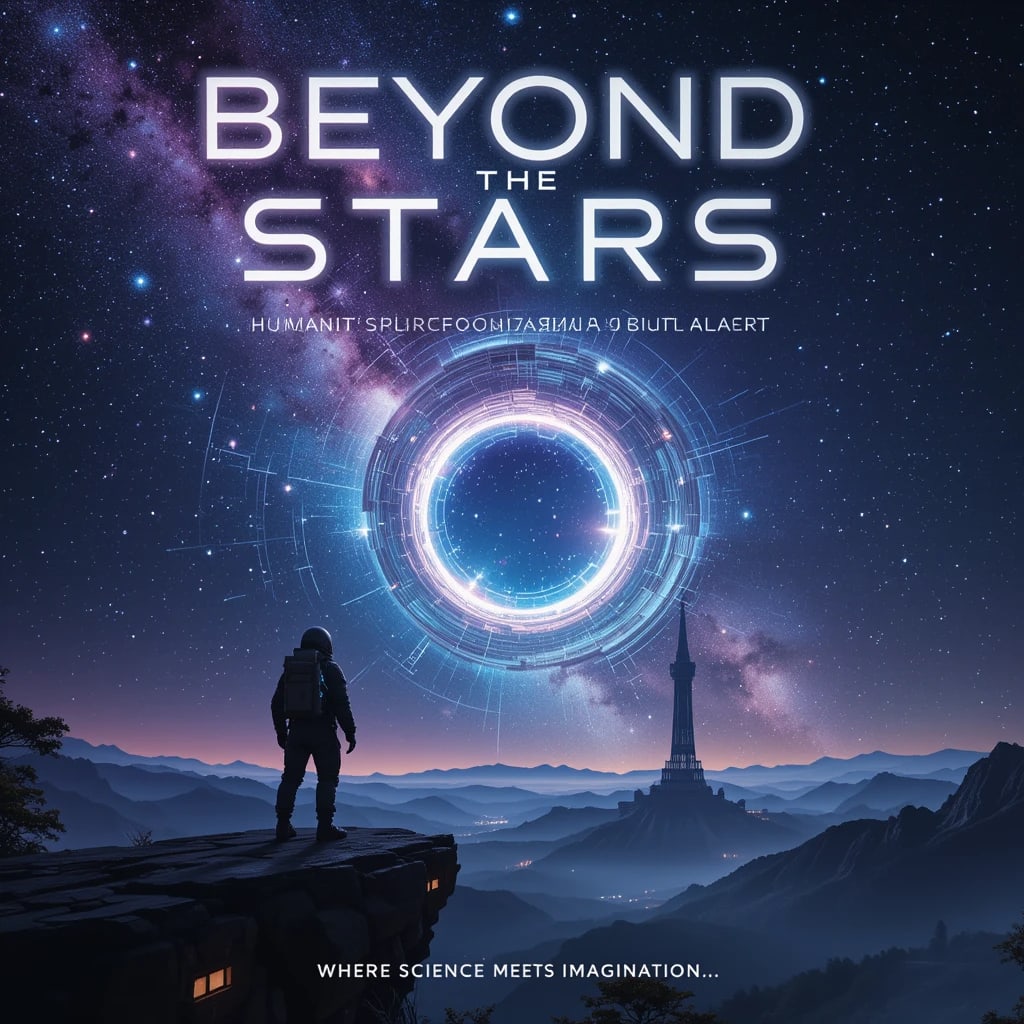
"The Edge of the Horizon"
By the year 2989, humanity had become a species of stars — but the galaxy still held its boundaries.
Earth had long since become a museum planet. Most humans now lived aboard star-faring arcologies orbiting the great arms of the Milky Way, or on terraformed moons scattered like seeds among stellar systems. The speed of light had remained the universe’s unbroken law — until the wormhole opened.
It wasn’t discovered by accident. The “Intergalactic Aperture Project” had spent centuries studying Einstein-Rosen bridges, scanning space for telltale gravitational waves and quantum echoes. Finally, on a lonely outpost at the galactic rim, orbiting a supermassive black hole known as M-77 Cygnus, the wormhole was detected.
They named it Icarus Gate.
It pulsed like a wound in space — a swirling tunnel of light, wider than Saturn’s rings. What was on the other side was unknown, perhaps a galaxy billions of light-years away, or perhaps nothing at all. For over 40 years, scientists sent unmanned drones through the Gate. Most vanished. A few returned, their memory cores scrambled. But one — Voyager Vela — came back intact.
Inside its databanks were images no one had seen before: stars arranged in constellations that didn’t exist in any known galaxy, gas clouds shaped like arcs of fire, and structures — impossibly large structures — silhouetted against alien suns.
The data was clear: there was something beyond. Something vast, ancient, and waiting.
Command was given to prepare the first crewed mission outside the Milky Way.
The Odysseus, a city-sized spacecraft equipped with quantum shielding, fusion drives, and a living biosphere, was selected for the crossing. Aboard were 400 of humanity’s brightest minds — scientists, engineers, philosophers, artists — selected not only for survival, but to represent what it meant to be human.
Among them was Dr. Elara Soren, a wormhole physicist who had dedicated her life to theoretical cosmology. Her mother had worked on the aperture algorithms that found the wormhole. Her grandfather had written the original equations on quantum spacetime.
To Elara, the mission was more than science. It was personal. A legacy.
The crossing was set for Solstice Day — a symbolic nod to Earth's longest night.
As the Odysseus approached the Icarus Gate, Elara watched from the observation dome. The wormhole shimmered with energy, its edges flickering between reality and mathematics. Her heart pounded — not with fear, but with awe.
"We stand at the edge of everything we know," she whispered.
The ship entered the wormhole at precisely 12:01 Galactic Time.
What followed was beyond time, beyond description. Colors without names danced through their viewports. The fabric of space twisted like silk. For a moment, Elara felt herself unanchored — aware of every point in space at once, and yet nowhere at all.
Then the tunnel collapsed behind them.
The Far Side
They emerged in a quiet sector of dark space — a black void lit only by distant galaxies. Stars blinked far apart, and a strange blue glow pulsed in the distance. There was no sign of danger, but the ship’s AI — KAIROS — reported a time dilation anomaly: only 9 minutes had passed aboard, but 73 years had elapsed in the Milky Way.
The crew gasped. Everything they had known was decades gone.
Still, their mission continued. They scanned the region, plotted the gravitational maps, and cataloged the alien sky. What they discovered stunned even the most jaded explorers:
A stellar ringworld, 4,000 times the size of Earth, orbiting a binary star system.
Signs of bio-mechanical structures, absorbing radiation and emitting patterns that resembled language.
And most hauntingly — a signal. It came every 13 hours. It wasn’t random. It wasn’t natural. It was an encoded message.
The AI translated it:
"You are not the first."
The Lost and the Legacy
The message shattered their assumptions. Someone — or something — had made this crossing before. Perhaps even created the Icarus Gate.
Theories flourished. An ancient civilization? A precursor race? Survivors of a cosmic extinction?
Elara dove into the data. Her team tracked the signal to a massive object drifting in a dead system — an artificial world. They called it the Reliquary. Landing was impossible — the surface was surrounded by kinetic defenses. But a single probe managed to enter a spire and transmit data before it was destroyed.
Inside was a chamber filled with statues — not of aliens, but of humans. Or something eerily close.
“They’re us,” Elara whispered. “Or what we become.”
One statue held an inscription in Latin. It read:
“Per aspera ad astra — through hardship to the stars.”
The Return Decision
The crew was faced with a choice: remain and study the unknown, or return and warn humanity of what lay beyond. The wormhole was stable for only one more crossing in their lifetime. Use it, or lose it.
They voted.
Elara chose to stay.
Half of the crew left aboard a smaller vessel. The other half — scientists, artists, dreamers — remained on the far side, founding a new colony in orbit around the Reliquary.
Before they parted, Elara sent a message through the Gate:
“To Earth: We are not alone. We were never alone. The universe is larger than fear, older than memory. Beyond the Milky Way lies not death, but destiny. Follow us.”
Epilogue: A Billion Years Later
Long after Earth’s sun faded, long after the Milky Way merged with Andromeda and became a dead galaxy, a new species emerged on the far side of the cosmos. They did not remember Earth. But they remembered Elara’s name.
And in their libraries, written in languages no human had ever spoken, one story remained unchanged:
"The First Ones crossed the Gate and became the Light."
About the Creator
Keep reading
More stories from writers in 01 and other communities.
Daniel Raphael Dreamporting Review: What to Know Before You Join
Personal development programs often promise clarity, growth, and transformation—but the experience can vary widely depending on the approach and the individual. Dreamporting, founded by Daniel Raphael, is one such program that attracts curiosity, discussion, and mixed opinions. Rooted in mindfulness and consciousness-based development, it stands apart from more conventional coaching systems.
By Jeffrey D. Gross MD6 days ago in 01
Candace Owens pushes theory Charlie Kirk was 'time traveller' who went to 'X-Men school'
In a recent episode of her podcast, Candace Owens said Charlie Kirk told her he was a “time traveler” who was sent to “X-Men school,” and alleged he was monitored since childhood.
By Dena Falken Esq2 days ago in 01


Comments
There are no comments for this story
Be the first to respond and start the conversation.