
Building AI Agents for Legal Support: Hard Lessons from the Field
The Legal AI Grind: Hard Lessons from the Front Lines of Law and Code

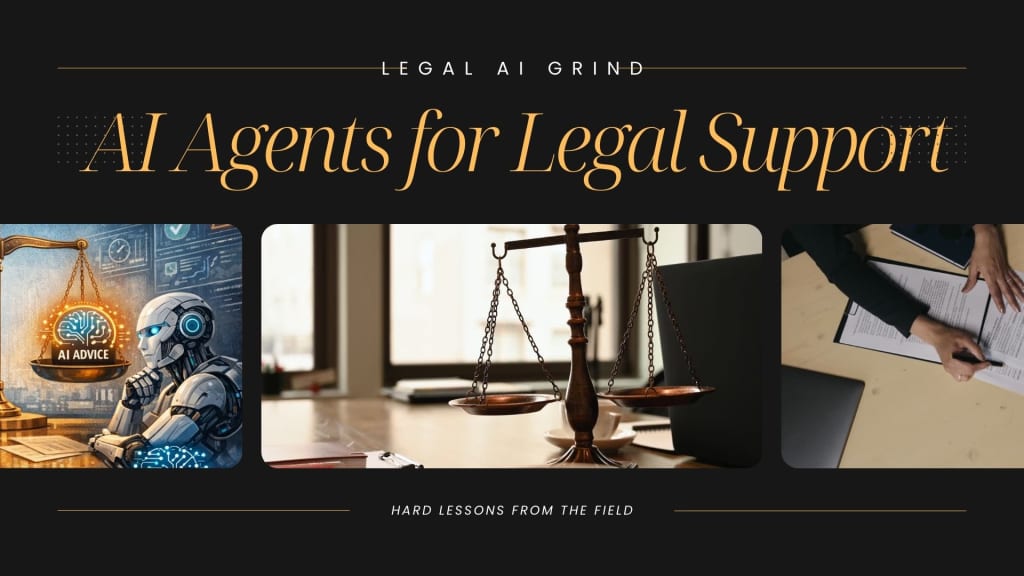
We’ve all heard the pitch: AI is going to revolutionize the law. The vision usually involves a digital associate that can scan ten thousand contracts by lunch and never miss a typo. It sounds great on paper, but for those of us actually building these agents, the reality is a lot grittier. The legal sector is where "easy" AI ideas go to die.
The stakes are just different here. If a retail chatbot suggests the wrong shoes, it’s a minor annoyance. If a legal AI misses a "change of control" clause in a merger, it’s a multi-million dollar malpractice suit. In this world, "almost right" is just another way of saying "wrong." After years of trial and error, we’ve learned that building for lawyers requires a completely different playbook.
1. Data Isn't Just "Messy"—It’s Intentionally Complex
In the AI world, we love to say "data is the new oil." In the legal world, data is more like unrefined ore buried under miles of granite.
Legal data is notoriously unstructured. You aren't dealing with clean spreadsheets; you’re dealing with PDFs of court rulings from 1984, internal memos written in "lawyer-speak," and contracts that use five paragraphs to say what could be said in one sentence. General AI models, the ones trained on Reddit threads and Wikipedia, fall apart here.
The biggest lesson? Preprocessing is 80% of the battle. You can’t just feed raw data into an agent and hope it learns. You have to invest in brutal data cleaning and meticulous annotation. Furthermore, confidentiality is a massive wall. You can’t just "scrape" client data to improve your model without violating every ethical rule in the book. Building legal AI requires a "security-first" mindset that most developers find stifling, but it is the only way to survive.
2. The Nuance Trap: Why "Shall" vs. "May" Matters
The distinction between you must do this and you should do this is thin in a normal conversation. In a contract, what shall is, as opposed to what may be, is the distinction between a binding and an optional suggestion.
Legal reasoning is context- heavy. A clause that is perfectly valid in New York might be completely unenforceable in California. Agentic AI systems often struggle with this jurisdictional drift. They tend to oversimplify. They look for patterns, but the law is often defined by the exceptions to the patterns.
We’ve learned that general-purpose Natural Language Processing (NLP) is just a starting point. To make an agent truly useful, you have to teach it the weight of specific legal terms. You have to encode the implicit knowledge that a senior partner has in their head but never writes down. If the AI doesn’t understand the intent behind the language, it’s just a very fast, very expensive autocorrect.
3. The "Human-in-the-Loop" Ego Check
There is a lot of fear in the legal industry about AI "replacing" lawyers. From what we’ve seen in the field, that fear is misplaced. The most successful AI agents aren't the ones that work alone; they’re the ones that know how to "hand off" to a human.
We call this the Human-in-the-Loop model, and it is non-negotiable.
An AI agent might be able to scan 500 NDAs and flag every "non-standard" clause. That’s the heavy lifting. But the lawyer is the one who has to decide why that clause matters in this specific negotiation. The agent is the researcher; the lawyer is the strategist
The hardest lesson for developers to learn is that the AI shouldn't make the final call. It should provide the evidence, highlight the risk, and then step aside. Accountability cannot be outsourced to an algorithm.
4. Integration: The "Silent" Project Killer
You can build the most brilliant, high-accuracy AI agent in the world, but if it requires a lawyer to leave Microsoft Word and log into a separate, clunky portal, they will never use it.
Lawyers live in their emails and their document management systems. They are busy, stressed, and notoriously resistant to change. The technology has to meet them where they are. We’ve seen "technically perfect" AI projects fail simply because they disrupted the existing workflow too much.
The lesson? Incremental adoption beats a "Big" launch every time. Start by automating one tiny, annoying task, like naming files or checking for missing signatures. Once the team trusts the AI with the small stuff, they’ll let it help with the big stuff.
5. The Speed and Accuracy
In most industries, AI is sold as a way to do things faster. In law, faster is a trap if it compromises "accurate."
There is a constant tension here. An over-cautious AI will flag every single sentence as a potential risk, creating so much "noise" that the lawyer ends up doing more work than they did before. But an over-confident AI that misses a subtle conflict-of-interest clause is a liability.
Calibrating these agents is an art form. It requires a constant feedback loop where lawyers grade the AI’s homework. It takes months, sometimes years, to find the sweet spot where the agent provides maximum efficiency with minimum risk.
6. The "Black Box" Problem
Lawyers are educated to demonstrate their performance. When a lawyer is arguing in court, he/she must refer to the previous case. AI, however, tends to be a black box; it just answers but does not comprehend how it reached there.
Anything that the AI said so is not an answer in a legal context. We have come to know that explainability is not an afterthought feature. When an agent detects a contract as high risk, it must have the capability to indicate the specific sentence that led to the flag and the rationale as to why the sentence is inconsistent with the policy of the company. The only way to accomplish the trust needed to be adopted is through transparency.
Conclusion
Building AI for the legal field is a high-reward, high-risk endeavor. It requires a rare blend of great technical skill and an even deeper understanding of the law.
The "hard lessons" boil down to this: respect the data, respect the human, and respect the nuance of the language. In the legal industry, using “general” AI to save time usually backfires and creates more problems than it solves. But if you build with patience, transparency, and a focus on the actual workflow of a lawyer, you can truly change the way justice and business are done.
The future of law isn't just about code; it’s about clarity. And the best AI agents are the ones that help us find it.
About the Creator
Jerry Watson
I specialize in AI Development Services, delivering innovative solutions that empower businesses to thrive.
Keep reading
More stories from Jerry Watson and writers in 01 and other communities.
The Future of Natural Language Processing: Trends to Watch in 2025 and Beyond
Natural Language Processing has not yet taken center stage in digital transformation as a key technology, but it has grown into a specialized area of study. People now rely on it to run various tools like voice assistants, chatbots, advanced search systems for businesses, and live translation tools. As artificial intelligence, large language models, and business use keep advancing, NLP will grow at a faster pace as we head into 2025 and the years after.
By Jerry Watson5 months ago in Journal
Stories Before a Wedding, or The Happily Ever After of Cinderella
Cinderella had always dreamt of marrying a prince. She had dreamt of nothing else since she was a small girl. Now, however, as the Prince’s wife of three days, she had to admit that the reality was not as she had dreamt it to be.
By Dionearia Red2 days ago in Fiction



Comments
There are no comments for this story
Be the first to respond and start the conversation.