
Budgeting for Your Quarry: Price Ranges for 50 TPH and 100 TPH Stone Crushers
Price Ranges for 50 TPH and 100 TPH Stone Crushers


Establishing a viable quarry operation requires a precise and unsentimental financial plan, with the stone crusher plant representing the single most significant capital expenditure. For small to mid-sized operations, throughput capacities of 50 and 100 tons per hour (TPH) are common targets. Understanding the stone crusher plant price ranges for equipment at these scales is not about finding the cheapest option, but about comprehending the value engineering and system requirements that define each tier. A quoted price for a bare crusher is a misleading figure; the true financial commitment encompasses the complete production circuit and its installation. This analysis provides a framework for budgeting, moving from core machinery costs to the total project capital required to achieve operational status.
Establishing the Financial Baseline: Core Crusher Investment Ranges
The price for a primary crushing setup is dictated by capacity, robustness, and technological level. For a 50 TPH plant, the entry point typically involves a simple, robust configuration. A common setup might include a single toggle jaw crusher as the primary, paired with a small secondary impact crusher or cone crusher for improved product shape. Prices for this complete crushing unit, excluding conveyors and screens, can range from approximately $65,000 to $120,000. The lower end of this spectrum often corresponds to simpler, fixed-frame designs with basic motors and controls, potentially sourced from certain regional manufacturers. The higher end incorporates more durable components, heavier-duty bearings and frames, and basic automation for controlling feed rates.
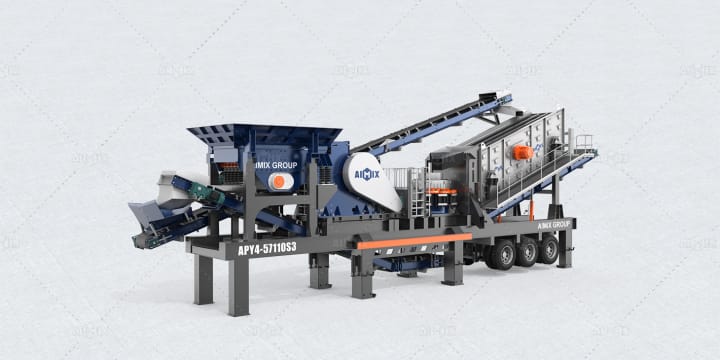
Stepping up to a 100 TPH capacity introduces a significant shift in both engineering and capital required. The machinery must be substantially more robust to handle the increased mechanical stresses and sustained throughput. A typical 100 TPH primary mobile jaw crusher will be a larger physical size with a more powerful drive. The secondary stage often requires a more capable cone crusher to maintain product specification at the higher volume. Consequently, the price range for the core crushing unit in a 100 TPH configuration broadens and elevates, generally falling between $140,000 and $250,000. This tier begins to include more advanced features as standard, such as hydraulic adjustment systems for wear compensation, integrated automation for load management, and more sophisticated bearing and lubrication systems designed for continuous operation. The investment here is not merely for more capacity, but for greater durability and reduced downtime per ton crushed.
The Total System Cost: Ancillary Equipment and Hidden Capital Outlays
The crusher itself is only the centerpiece of a working production line. Failing to budget for the ancillary system guarantees project delays and financial shortfalls. A functional plant requires a feeding system, such as a vibrating grizzly feeder to regulate material flow and remove fine debris. It requires a network of conveyors to move material between crushing stages and to stockpiles. It requires at least one, and often two, screening decks to size the product. The cost for this essential peripherals—feeder, conveyors, screens, and electrical controls—can easily add 50% to 100% to the cost of the core crushers. For a 50 TPH system, this means an additional $40,000 to $100,000. For a 100 TPH system, add $80,000 to $200,000 or more.
Furthermore, several critical costs exist outside the equipment purchase. Site preparation is a major item, involving clearing, grading, and creating stable foundations for heavy machinery. Electrical infrastructure must be brought to the site, potentially requiring transformers and new service lines. Professional installation and commissioning by qualified technicians is an absolute necessity and represents a significant line item. Finally, no operational budget is complete without an allocation for initial working capital and spare parts inventory. The first months of operation will consume fuel, wear parts like liners and screen meshes, and require labor before steady revenue is established. A prudent budget allocates 20-30% of the total equipment cost for these installation and startup expenses.

Strategic Selection: Aligning Crusher Choice with Quarry Economics
The choice between a 50 TPH and a 100 TPH system is ultimately a strategic business decision, not just an equipment selection. The harder and more abrasive the stone, the more robust—and expensive—the crusher needs to be, regardless of throughput. A 50 TPH stone crusher plant processing soft limestone will be at the lower end of the cost scale, while a 50 TPH plant processing abrasive granite will trend toward the higher end due to the need for more wear-resistant alloys and heavier construction.
The decisive calculation is the payback period. A 100 TPH plant requires roughly double the capital investment of a 50 TPH plant but can produce double the output. If the market can absorb the volume and the raw material reserve is sufficient, the higher-capacity plant typically offers a lower cost per ton and a faster return on investment due to economies of scale. However, if the market is limited, the deposit is small, or access is constrained, the lower capital exposure of a 50 TPH plant may present a lower financial risk and an acceptable return. The correct budget is the one that aligns the plant's capacity and cost with the realistic sales volume, material characteristics, and financial resources of the quarry enterprise. The goal is to match the system's output to a demonstrable demand, ensuring the capital invested generates a swift and sustainable return.
About the Creator
consrtuctionmachines
AIMIX is a customer-center-oriented heavy equipment manufacturer and supplier, devoted to production, innovation, combination, one-stop solution, etc.
https://aimixgroup.com/
Keep reading
More stories from consrtuctionmachines and writers in 01 and other communities.
Efficiency of Auto Concrete Mixer Machine for Remote and Large Construction
Building in remote areas or managing large sites brings clear challenges. You face limited access, fewer resources, and tight timelines. Transporting mixed concrete over long distances is costly and slow. That’s where an auto concrete mixer machine helps.
By consrtuctionmachines2 months ago in 01
Maximizing App ROI via Predictive Analytics in 2026
The landscape of mobile engagement has shifted. In 2026, acquiring a user is not the only success metric. The true value lies in the Lifetime Value (LTV). LTV measures the total revenue a user generates over time. For many firms, acquisition costs have risen by 20%. This has happened over the last two years. Platform saturation and new privacy laws are the main causes. To stay profitable, businesses must pivot their strategy. Move from reactive support to proactive retention.
By Devin Rosario5 days ago in 01
Top Benefits of Agentic AI Pentesting for Modern DevOps and Cloud Security
Introduction Cloud security has shifted from perimeter defense to identity governance. Modern environments now span distributed workloads, dynamic permissions, and layered trust relationships that evolve continuously. Yet industry research shows that nearly 70% of cloud security incidents are tied to misconfigurations and excessive access permissions.
By Sam Bishop3 days ago in 01



Comments