
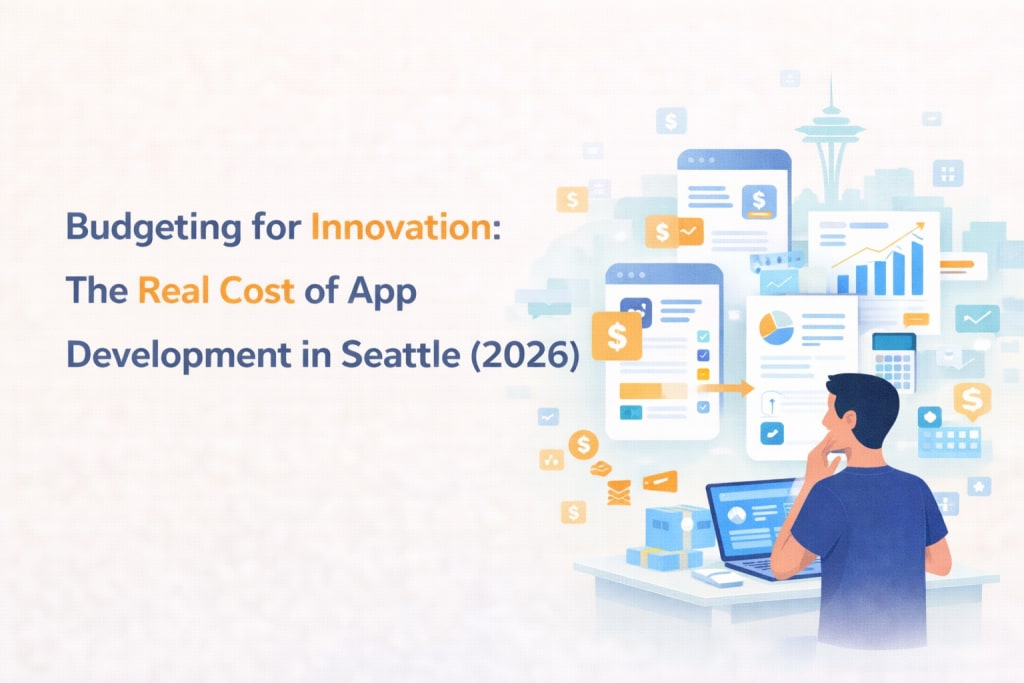
Budgeting for Innovation: The Real Cost of App Development in Seattle (2026)
Why the "Amazon Premium" and AI integration have redefined the price of entry for Pacific Northwest startups.

When I sat down with a prospective client in a coffee shop in South Lake Union earlier this year, I could see the sticker shock on his face before I even finished the sentence. He had come in with a budget based on a blog post he read from 2023. He left realizing that in 2026, the game has completely changed.
Seattle is no longer just a tech hub; it is the global capital of cloud computing and a primary battleground for the AI revolution. Navigating the mobile app development Seattle ecosystem today requires more than just a great idea—it requires a war chest and a strategy.
Often lazily labeled "Silicon Valley North," Seattle has a business DNA that is entirely its own. It is a market defined by enterprise-grade stability, privacy-first architecture, and a talent pool that is as expensive as it is brilliant. For founders and CTOs, here is the unvarnished reality of what it costs to build here, backed by the latest 2025-2026 market data.
1. The "Amazon Premium" on Talent is Real
In most cities, if you want to hire a mobile developer, you are competing with other local agencies. In Seattle, you are competing with Amazon, Microsoft, and OpenAI.
This creates what I call the "Amazon Premium." You cannot simply offer a competitive market rate; you have to offer a reason for top-tier talent to walk away from restricted stock units (RSUs) and golden handcuffs.
- The Data: According to recent 2025 labor market reports, the average base salary for a mobile developer in Seattle now hovers between $163,000 and $180,000.
- The AI Spike: If you need a specialist capable of integrating Generative AI (which is practically a requirement now), that number jumps to $200,000 - $250,000+.
The Lesson: If you are building an app here, do not budget for "average." The local talent pool is elite—the Puget Sound region boasts the third-largest cluster of AI-specialty talent in the U.S.—but they come with a premium price tag. I learned to stop looking for "cheap developers" and started looking for "high-velocity engineers" who cost more per hour but build three times faster.
2. The New Definition of "MVP" (Minimum Viable Product)
In the startup world of 2020, an MVP was often a duct-taped prototype meant to test a hypothesis. In Seattle’s 2026 market, that definition doesn't fly.
Because the region is dominated by enterprise culture (thanks to the cloud giants), the bar for quality is set incredibly high. Local investors and B2B clients here are used to the stability of Azure and AWS. They have zero tolerance for "move fast and break things" if "breaking things" means data leaks or downtime.
2026 Cost Benchmarks for Seattle Development:
- Simple Utility App: $40,000 – $80,000 (Basic functionality, no custom AI).
- Mid-Complexity App: $80,000 – $150,000 (Custom UI, API integrations, standard backend).
- Enterprise/AI-Driven App: $250,000 – $500,000+ (Real-time data processing, custom LLM integration, high security).
The Lesson: I stopped pitching "quick and dirty" pilots. In Seattle, MVP stands for Maximum Value Protocol. It needs to be secure, scalable, and compliant from Day 1.
3. AI is No Longer an "Add-On"—It's the Architecture
Two years ago, adding AI to your mobile app was a differentiator. Today, in the cloud capital of the world, it is the baseline.
With 61.8% of the region's tech talent employed by the industry giants driving AI innovation, users in Seattle expect apps to be "predictive," not just "reactive." They don't want to search for a solution; they want the app to offer it before they ask.
- The Cost of Intelligence: Integrating a basic AI chatbot might only add $5,000 - $15,000 to your build. However, building a custom "Agentic AI" system—one that autonomously performs tasks for the user—can easily add $150,000+ to your budget.
- The ROI: Despite the cost, the market demands it. 2025 data suggests that AI-integrated apps in the productivity sector are seeing retention rates 20-30% higher than their non-AI counterparts.
The Lesson: If your app isn't "smart," it's dead. At Indi IT Solutions, we had to radically shift our stack. We stopped just building UIs and started integrating OpenAI and Azure Cognitive Services into the core of our development process.
4. The Hidden Cost of Retention
Launching the app is only the starting line. The real financial battle—and the one most founders forget to budget for—is keeping people on it.
The mobile market is brutal.
- Stat: Recent 2025 benchmarks show that the average mobile app sees a Day 1 retention rate of only ~28%.
- Drop: By Day 30, that number plummets to a terrifying 3-7%.
This means that for every $100 you spend acquiring a user, $93 of it walks out the door within a month if your product isn't sticky.
The Lesson: Budget for "Post-Launch Engineering." You will need to iterate rapidly in the first 90 days. I advise clients to reserve 20% of their initial budget strictly for post-launch optimization and A/B testing. In Seattle, where users are tech-savvy and impatient, a stagnant app is a deleted app.
5. The "Hybrid" Model: The Only Way to Scale
This was the hardest pill to swallow. I wanted to build a 100% local, in-house team. But the economics (see Lesson #1) made that impossible for a growing agency.
However, the alternative—outsourcing everything to a cheap offshore shop—is statistically dangerous.
- The Risk: Reports indicate that 50% of failed outsourcing projects cite "poor project alignment" or "unclear scope" as the primary cause.
- The Failure Rate: Even more alarming, 70% of digital transformation projects fail to meet their original goals, often due to communication breakdowns.
The solution that is dominating the mobile app development Seattle scene in 2026 is the Hybrid Model.
- Local: Strategy, Project Management, System Architecture (The "Brain").
- Global: Backend execution, QA testing, maintenance (The "Muscle").
The Lesson: Don't hide your distributed team; optimize it. Reports show that 83% of companies using staff augmentation plan to continue doing so because it works. We now pitch this as a benefit: "You get Seattle-tier architecture with global-tier speed." It allows for a 24-hour development cycle that purely local teams can't match.
Conclusion
Seattle is not for the faint of heart. It is a high-stakes, high-cost, high-reward environment. But the discipline it forces upon you—to build better, to think smarter, and to value substance over style—makes you a better developer and a better entrepreneur.
The "real cost" of building an app here isn't just the line item on the invoice. It's the cost of competing with the best. If you can survive the rain and the rates, you can build anything here.
About the Creator
Nick William
Nick William, loves to write about tech, emerging technologies, AI, and work life. He even creates clear, trustworthy content for clients in Seattle, Indianapolis, Portland, San Diego, Tampa, Austin, Los Angeles, and Charlotte.
Keep reading
More stories from Nick William and writers in 01 and other communities.



Comments
There are no comments for this story
Be the first to respond and start the conversation.