
Best Vocal Removers for Professional Music & Video Production: 2026 Selection
Ultimate selection of the best vocal removers suitable for professional music and video production tasks.


For years, vocal remover tools were treated as niche utilities, useful for karaoke tracks or quick DJ edits. That reputation no longer holds. In 2026, stem separation sits at the center of modern audio workflows, used not just by producers and engineers, but by post-production teams, broadcasters, automotive UX designers, and localization studios.
The term itself has become outdated. Today’s tools do far more than isolate vocals from instrumentals. They split mixes into drums, bass, guitars, keyboards, strings, backing vocals, and dialogue layers, often with a level of clarity that would have required original multitrack sessions just a few years ago.
This article reviews the best vocal removers and stem separation tools available in 2026, with a focus on professional use cases rather than casual experimentation.
Why Vocal Removal Still Matters in 2026
Audio production has grown more modular. According to the Data Insights Market’s report, the broader vocal remover market is valued at $390 million in 2025, projecting an 8.2% CAGR through 2033, which likely reflects growth from AI advancements and rising use in podcasting, video editing, and industries beyond music production.
Songs are remixed across platforms like YouTube and TikTok, even Spotify has launched a feature that allows users to remix tracks right in-app, dialogue is repurposed for different languages, and sound assets move between music, video, and product design. At the same time, access to original stems remains limited. Labels, agencies, and studios rarely share full multitrack sessions outside tightly controlled environments.
Stem separation, and vocal removers particularly, fill that gap. Producers use it to extract clean vocals for remixes and edits. Film and TV teams rely on it when dialogue needs adjustment without access to production audio. Advertising agencies separate music beds to adapt tracks to different formats. Even automotive and product designers isolate voice layers to test how sound behaves inside interactive systems.
In all these cases, the question is no longer whether AI-based separation works, but whether it works well enough to fit into professional pipelines without introducing problems downstream.
How We Evaluated the Vocal Removers
To keep the comparison practical, the tools below were tested using real-world material rather than lab-clean demos. The source audio included commercially released tracks across pop, hip-hop, electronic, rock, and acoustic genres, as well as spoken-word recordings from podcasts and social video.
The evaluation focused on several factors.
First, separation quality. This includes vocal clarity, how well backing vocals are handled, and whether artifacts remain audible during quiet passages or sustained notes. Particular attention was paid to reverb tails, sibilance, and cross-bleeding of other instruments.
Second, stem depth. Some tools still limit users to vocal and instrumental splits, while others offer multi-stem outputs suitable for modern production.
Third, workflow integration. Web tools, desktop and mobile applications, plugins, and APIs were assessed differently, depending on how easily they fit into existing setups.
Finally, licensing and pricing models were considered, especially for teams working on commercial content.
LALAL.AI: Best Overall for Professional Vocal Isolation
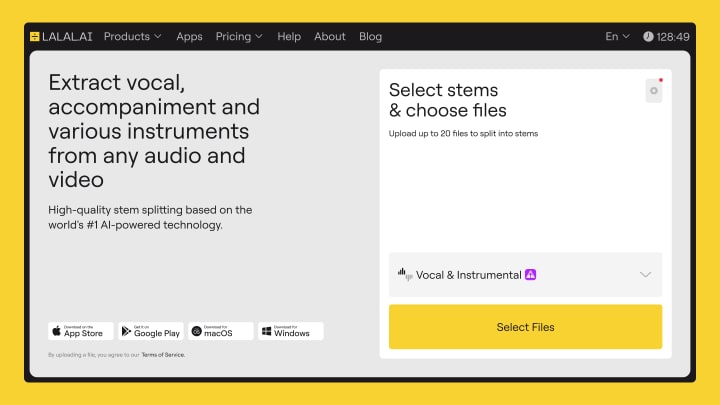
Among the tools reviewed, LALAL.AI stands out for its balance between separation accuracy and workflow flexibility. What began as a vocal and instrumental splitter has expanded into a multi-stem separation and voice modification platform capable of extracting drums, bass, piano, guitars, synths, strings, and several vocal layers (lead and backing vocals).
In testing, vocal isolation, powered by the new algorithm Andromeda, remained consistent even in dense, heavily mastered mixes. Lead vocals retained presence without excessive smearing, while backing vocals were separated cleanly enough to be treated independently. Reverb tails, often a weak point in AI separation, were preserved without the metallic artifacts common in earlier systems.
LALAL.AI’s strength lies not just in audio quality but in the way it’s used as well. The service is available as a web app, desktop software, apps for iOS and Android, an API for automated workflows, and a VST plugin that allows vocal isolation directly inside any DAW that supports a VST3 format. This makes it suitable for producers working on individual tracks as well as teams processing large libraries of audio.
Professional use cases extend beyond music. Automotive UX sound designers use it to split tracks into several layers when creating interactive music and soundscapes for cars. Post-production teams prepare dialogue stems for dubbing and localization, while content studios rely on batch processing to restore large archives of audio recordings.
The main limitation is that stem separation remains a preprocessing step. Like all tools in this category, the results benefit from the quality of the original source (the higher, the better), further editing if needed, and cleanup before final delivery.
Pricing: Subscriptions plan vary from Starter (free plan with limitations), Lite ($9.99/mo if billed monthly and $90 if billed annually), and Pro ($19.99/mo if billed monthly and $180 if billed annually). Additional top-ups and the Enterprise plan tailored specifically for businesses are also available.
iZotope RX Music Rebalance: Best for Post-Production Control
iZotope RX Music Rebalance is a module in iZotope's RX audio repair software suite and it approaches vocal removal from a different angle. Rather than focusing on exporting clean stems, Music Rebalance allows engineers to adjust the relative levels of vocals, bass, percussion, and other elements within a mix.
This approach suits broadcast and film environments, where subtle changes are often preferred over full extraction. Dialogue can be lifted slightly above music, or music reduced beneath narration, without rebuilding the entire sound design.
RX performs best on moderately complex material. On modern pop and electronic tracks with aggressive limiting and layered effects, its separation can feel restrained compared to dedicated stem tools. However, its strength lies in precision and predictability, which remain essential in post-production contexts.
Since this is a feature within iZotope's RX software suite, the tool is available in versions like RX 11 Standard and higher editions. Pricing varies by edition and licensing model, with RX 11 Standard typically retailing around $399 for a perpetual license.
Music Production Suite Pro, which includes RX with Music Rebalance, costs $24.99 monthly or about $250 annually, offering ongoing updates and additional tools. Lower-tier Producers Club access starts at $19.99 per month with core features.
Standalone RX upgrades or bundles like RX Elements may range from $100–$400 during sales, while full suites exceed $500; academic pricing lowers costs further. Check iZotope's site for current promotions, as discounts often apply.
Spleeter-Based Tools: Best Open-Source Ecosystem
Spleeter, originally developed by Deezer, continues to influence the stem separation tech through a wide range of community-driven tools. While the original project is no longer actively developed at the same pace, its models and derivatives remain widely used.
The appeal is flexibility. Developers and technically inclined users can adapt models, integrate them into custom pipelines, and experiment with different training approaches. For research, prototyping, or internal tooling, this openness is difficult to match.
That said, quality varies widely depending on implementation. Setup requires technical knowledge, and results are less consistent than commercial platforms trained on broader datasets. Spleeter-based solutions are best suited to teams that value control over convenience.
The service is free and available only as an online solution.
Ultimate Vocal Remover (UVR): Best for High-Quality Open-Source Vocal Isolation
Ultimate Vocal Remover (UVR) is a well-known tool in the audio separation community, especially among producers, engineers, and hobbyists who work with stem splitting without paying for commercial services. It’s widely referenced as one of the strongest free solutions for vocal and instrumental separation.
This is an open-source stem separation application that uses modern neural network models to split an audio file into isolated elements. At its core, it’s a desktop tool available for Windows, macOS, and Linux, though there are also web-hosted versions that let you run it in the browser.
Unlike very simple frequency-based vocal removers of the past, UVR uses multiple AI architectures, including MDX-Net, Demucs, and other community-developed models to achieve high-fidelity results on complex mixes. Many of the models it runs were developed by the project contributors and trained on large datasets to distinguish vocals, drums, bass, and other instruments based on learned patterns rather than fixed filters.
Users note that UVR often matches or even exceeds the quality of paid tools on certain material, especially for basic vocal/instrument splits. It performs well on mainstream music genres and is frequently recommended in producer forums for that reason. However, it can be slow on CPU-only machines and may require careful tuning to avoid artifacts or phase issues.
UVR is available via GitHub for download and community contributions.
VocalRemover: Best for Ease of Use
VocalRemover.org is an online AI-powered vocal isolation and stem separation tool that lets users upload audio files and get separate vocal and instrumental (or other) tracks generated in the browser. It’s positioned as a free, web-based solution and is widely used by hobbyists, musicians, and casual content creators who want quick vocal removal without installing software.
VocalRemover.org uses artificial intelligence models to separate vocals from the rest of a music track. After uploading an audio file (MP3, WAV, FLAC, etc.), the service processes it and provides downloads of the isolated vocals and instrumental versions.
The platform includes additional utilities such as basic audio editing, tempo/pitch adjustments, and sometimes music splitting into parts like drums or bass, though these features are generally simple compared to full DAW tools.
The base service doesn’t charge, which makes it easily accessible to people experimenting with vocal isolation.
Common Mistakes When Using Stem Separation Tools
Despite advances, stem separation is not magic. One common mistake is expecting clean results from aggressively limited masters. Heavy compression reduces the information available for separation, making artifacts more likely.
Another issue arises during reintegration. Poor gain staging or phase alignment can undo the benefits of clean separation. Treating AI-generated stems as final assets, rather than intermediate material, often leads to disappointing results.
The State of Vocal Removal in 2026
Vocal removal technology has matured into a dependable part of professional audio work, with the focus having shifted from novelty to reliability. Tools now offer finer stem granularity, better handling of live recordings, and tighter integration with production software.
All in all, in 2026, vocal removers are no longer shortcuts or party tricks. They are production tools, used daily by professionals across industries. The best results come not from chasing the newest feature, but from choosing tools that match the realities of a given workflow.
Stem separation continues to settle into the background of audio production, and its value lies in how quietly and reliably it does its job.
About the Creator
LALAL.AI
LALAL.AI is an AI-powered stem separation service that enables businesses and creators to extract vocals, instruments, and dialogue with unmatched precision, making it an essential tool for sound and video pros.
What You Need to Know About Mobile App Development in Charlotte?
The image of technology innovation once centered on a small group of global cities where venture capital flowed freely and startups competed for attention under constant spotlight. That narrative has begun to change. Today, many successful digital products emerge from regions where innovation grows quietly through industry partnerships, practical problem-solving, and steady ecosystem development rather than headline-driven hype.
By Mike Pichai2 days ago in 01
I Don't Need My Phone... Wait, Is That Actually True?
My parents gave me my first cell phone when I was twelve years old. It wasn't a fancy iPhone or anything, not even close. Just a simple black flip phone for when I needed to call or text them after school.
By Madison "Maddy" Newton6 days ago in Humans




Comments
There are no comments for this story
Be the first to respond and start the conversation.