
Best Agile Practices To Make Project Management More Efficient
Agile project management

The Agile Manifesto has gained a lot of popularity amongst the software development teams. Agile development practices are helping organizations deliver the desired value and outcomes at a rapid pace. Agile teams are more productive than traditional development teams since they create higher quality products while satisfying the customers more consistently by meeting their expectations. It is one of the main reasons why businesses are now keen on adopting Agile best practices in project management.
How Is Agile Different From Traditional Software Development?
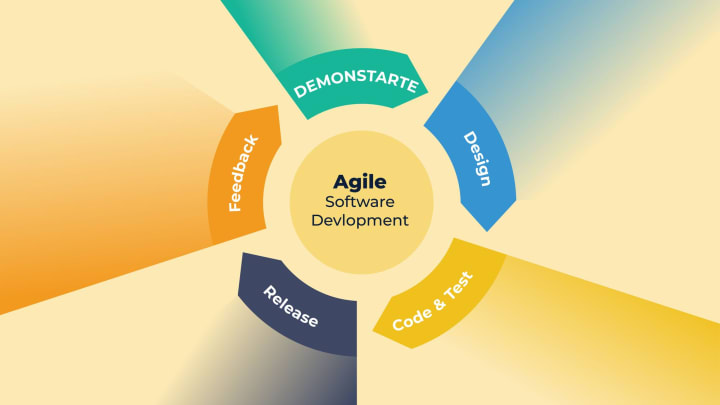
Traditional software development follows the classic waterfall methodology.
That means teams develop a detailed project plan first and then launch it into a linear, stepwise development process. They have very rigid deadlines and zero deviations. If you need to change something later, you can’t, or if you do, it costs you a lot.
This is the part where Agile teams come into the picture — rather than planning the entire project upfront, Agile teams focus on planning continuously throughout the project, providing you scope for making constant adjustments as and when required.This is yet another reason why organizations are turning to Agile management practices in project management. Other benefits of adopting the agile mindset in software development include:
- Most organizations are operating in dynamic market environments. To adapt to these changing markets, they need Agile teams that can work within short development cycles and help them achieve a faster time-to-market.
- Agile teams are gaining momentum quickly in this tech-driven space since they are more innovative, adaptable, and responsive to rapidly changing conditions than traditional teams do.
- Agile teams can potentially deliver tested, working software in just two to four-week iterations.
- Agile teams use efficient, collaborative methods to produce frequent, high-quality, sustainable releases.
Wondering how is that possible? An Agile team is generally comprised of three to ten highly skilled people who work together full-time in close proximity. Every team member represents a diverse functional area, such as programmers, designers, testers, analysts, technical writers, etc.
Most importantly, the team collaborates with a learning attitude, growing with every iteration and continuously adding to the best Agile practices list that guides them further.
To Understand Agile Project Management Best Practices, We Must First Understand the 12 Agile Principles
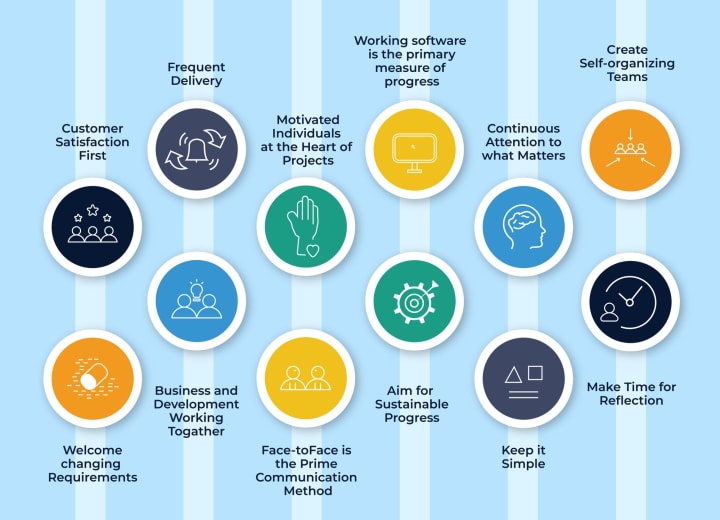
The first step towards understanding the Agile best practices in project management is to know about the Agile principles. We have 12 guiding principles for Agile software development, laying their foundation on the Agile Manifesto’s core values.
Half of these principles are related to the human side of software development because it is not processes and plans but the interactions between people that make for successful product delivery. Here are the 12 Agile principles:
- Satisfying the customer must be your highest priority. Use early and continuous delivery of valuable software to achieve this.
- Welcome changing requirements, irrespective of when they arise in development. Agile processes are about harnessing change to provide customers with a competitive advantage.
- Make sure you deliver working software frequently, trying to keep the timescale as short as possible.
- Ensure that business people and developers collaborate daily throughout the project.
- Focus on building result-driven projects around motivated individuals. Put your faith in them and give them the environment and support they need.
- Use face-to-face conversation to convey information since it is the most efficient and effective method for the same.
- The primary measure of progress must be working, functional software.
- Remember that Agile processes promote sustainable development. Hence, make sure that everyone — users, developers, and sponsors — is able to maintain a constant pace.
- Pay proper and continuous attention to technical excellence and good design since it enhances agility.
- Simplicity is essential.
- Self-organizing teams are an ideal source of origin for scoring the best designs, architectures, and requirements.
- Ensure that your team shows progress, understands how to be more effective, and changes its behavior accordingly.
List of Agile Best Practices for More Efficient Software Development

Here is the Agile practices list and your complete guide to Agile best practices in project management:
Collaborate With the Customer
Customers are satisfied only when you meet their expectations and needs, but software developers often fail to understand them since they are short on mindreading. Hence, they keep coming up with new ideas to discover client expectations and deliver exactly what they seek.
Traditionally, development teams first used to record user requirements at one end of the funnel. Then, they used to deliver the product at the other end, having no to zero customer interaction in between. That is how a traditional approach works.
However, in an Agile team, we understand client expectations using near-constant communication. Then, we collaborate on fixes and communicate all the possible options that we did not consider previously, which helps you promote creativity while improving quality.
Establish Iterations
Agile teams use time strategically by selecting the amount of work they need to do based on the available number of hours inside the team. Moreover, Agile teams deploy the task in iterations, allowing the team to decide what it can do based on its capabilities and experience from the previous iterations.
Follow a Customer-Oriented Approach
Agile methodology values customer collaboration to a greater extent and provides all the information required to the clients while keeping them posted on the progress of the development process. It ensures that there is constant communication in internal teamwork so everything runs smoothly.
Work Together Daily
Equating a group of people who work together in a team is a common pitfall among Agile teams. Teams and teamwork can only contribute to successful projects if they collaborate as a cohesive unit and work in sync.
Hence, you need to ensure that your team has seamless communication, coordination, the balance of team member contributions, mutual support, effort, and cohesion.
To Read Full Blog…
About the Creator
Keep reading
More stories from thirdrocktechkno2024 and writers in 01 and other communities.
AI Strategy in 2025: 10 Ways to Implement in Your Business
There is no doubt that AI will continue to be the most talked about technology in 2025. From the ed-tech to the healthcare industry, it’s only going to become more useful and integrated into our systems.
By thirdrocktechkno2024about a year ago in 01
How Mobile App Development Supports Charlotte’s Growing Businesses?
I didn’t always believe a mobile app was a growth tool. For a long time, I saw it as an add-on — something useful once a business was already large, already complex, already stretched. Growth, I thought, came from sales, partnerships, and operations. Technology just followed along.
By Mike Pichai2 days ago in 01
Transforming Developmental Support Through Data-Driven Digital Care Solutions
Operant Systems is at the heart of an emerging trend that is centered around quantifiable improvement and ethical care provision to people with autism spectrum. Centered on clinical rigor and practical implementation, the organization presents solutions that bring technology into the therapeutic objectives. In this context, the application of autism software and operant behavior (ABA) is placed in the role of complementary components that facilitate the process of structured learning, regular reinforcement, and transparent tracking of progress in care facilities in the United States.
By Kashif Khan3 days ago in 01




Comments
There are no comments for this story
Be the first to respond and start the conversation.