
Begin your DevOps Journey
How to become a DevOps Engineer.....


Do you hear the term DevOps very often these days ? Do you find posts on DevOps every time you open your Linkedin ?
Are you looking for a career shift towards DevOps?
Are you a classic OPs guy and would like to know what does it take to become a DevOps engineer ?
Please read on to understand what is DevOps and the foundational technology stack in DevOps. You will also get to know what needs to be learnt to become a successful DevOps Engineer.
What is DevOps?
DevOps is a collaboration of operations and development teams for the entire application lifecycle for faster and reliable delivery of software applications. DevOps is a philosophy and a set of standard practices, needs to be fused among the team and it helps become more agile.
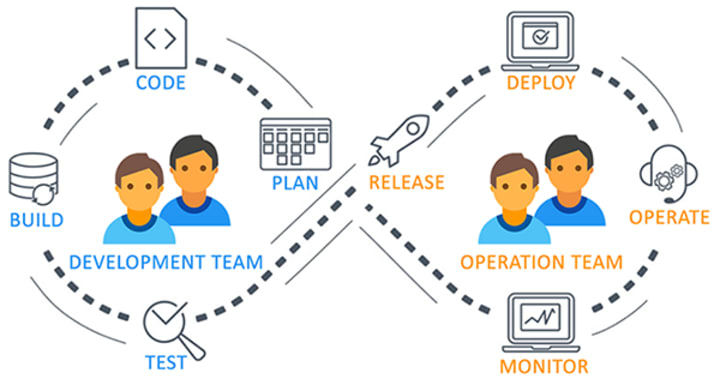
Technically speaking DevOps is building automated CI/CD (Continuous Integration/Continuous Deployments) workflows to convert source code residing in a code repository into a live working instance of an application.
Having said that there are no shortcuts to become a DevOps engineer, one has to learn DevOps, use best possible combination of the tools and apply standard/recommended practices in your work environment. And remember DevOps is here to stay, so this is the right time to get into it.
Learn DevOps
To transform career into DevOps one has to start learning latest, easy to learn and most widely used DevOps tools. There are different sub-domains of DevOps(discussed later in this blog) but despite of their differences there is one common fundamental technology stack for any path you choose. This stack is at the foundation of any DevOps role or a DevOps team. Let's discuss this in detail:
- Linux Essentials: Linux is at the heart of DevOps. It doesn't mean extensive linux knowledge, but you should have sufficient knowledge of basic linux commands, shell scripting, networking, system resources, etc. This helps you with the day-to-day activities.
- Version Control System: Git being the most popular source code management tool, you must learn basic git concepts and commands for regular code checkouts, check-ins, push/merge, etc.
- CI/CD: Understand the complete lifecycle of Continuous Integration/Continuous Deployment. DevOps is all about automating end-to-end CI/CD pipeline workflows. It helps DevOps team work in a systematic manner with frequent build and releases.
- Build Automation Tool: These tools help execute CI/CD lifecycles. Some of the very popular build automation tools are Jenkins, CircleCI, Travis, Bamboo, etc, with Jenkins is the most widely accepted among all of these.
- Configuration Management Tools: These tools helps execute pre/post activities on multiple remote servers and helps keep track of software configurations on multiple servers providing consistency. Some of the well known configuration tools are Ansible, Chef, Puppet, etc.
- Cloud Technologies: Get some hands-on any of the public cloud provider like AWS, GCP, Azure, etc. Choice of cloud provider is completely your's but keep in mind the fact that AWS has more job offerings than other two looking at the current market trend.
- Containers: You have got to love the containers for being a successful DevOps engineer. Docker is the popular container runtime engine and Kubernetes is the most widely used container orchestration engine.
Most of the above stated tools/technologies can be learnt easily using available resources over Internet. Pick one layer of the stack at a time, explore the possible choices, select a tools which seems more reasonable and start looking for online tutorials, youtube channels, udemy, e-books to get into the details and try to get real-time hands-on. DevOps has lots of certifications if one wants to pursue and it really gives you the edge. So if you are comfortable then go for it.
One more thing to highlight here is whatever we discussed till now gives you entry into the DevOps by learning basics of these technologies and getting your hands dirty on some of these tools. But to get extensive experience and to get to the next level of expertise there are multiple sub-domains DevOps has into which you can grow your resume, some of which are listed below:
- DevOps + CI/CD
- DevOps + Cloud(AWS/GCP/Azure)
- DevOps + Containers
- DevOps + IaaS
- DevOps + Hadoop & many more.....
Hope this clears out few things and gives you an idea on how to dive right into the DevOps. There is a lot about DevOps, tools, technologies and processes, which could not be covered as part of this blog. In case of any queries feel free to reach out to me or you can also follow me on LinkedIn(https://www.linkedin.com/in/tarishigupta/).
About the Creator
Reader insights
Outstanding
Excellent work. Looking forward to reading more!
Top insights
Easy to read and follow
Well-structured & engaging content
Expert insights and opinions
Arguments were carefully researched and presented
Eye opening
Niche topic & fresh perspectives
Heartfelt and relatable
The story invoked strong personal emotions
Keep reading
More stories from writers in 01 and other communities.
How to Choose the Best Mobile App Development Company in Canada 2026
Choosing the right app development partner in 2026 isn’t just a procurement decision—it’s a strategic move that can define whether your digital product scales or stalls. The Canadian tech ecosystem has matured rapidly, with agencies offering everything from rapid MVP builds to enterprise-grade platforms powered by AI and cloud-native architectures.
By alan michael5 days ago in 01




Comments (2)
xkhhxvxcvmxcnv,nxc,v
Excellent work. Looking forward to reading more!