
Bay Area: 23andMe Files for Bankruptcy—How to Delete Your Genetic Data
"Amid financial turmoil, here's what you need to know about protecting your DNA data."

Key Points
23andMe, a Bay Area genetic testing company, has filed for Chapter 11 bankruptcy protection, suggesting financial difficulties.
CEO Anne Wojcicki has stepped down but will remain on the board, with the CFO taking over as interim CEO.
California’s Attorney General recommends deleting genetic data due to privacy concerns, given the company’s instability.
Customers can delete their data, destroy samples, and revoke research consent through account settings, ensuring permanent erasure.
Direct Answer
Overview
23andMe, based in the Bay Area, has filed for Chapter 11 bankruptcy, a process that lets the company reorganize its debts while continuing to operate. This filing, made on Sunday night in Missouri federal court as of March 24, 2025, shows the company is facing financial challenges. CEO Anne Wojcicki stepped down immediately but will stay on the board, with CFO Joseph Selsavage now serving as interim CEO.
Why This Matters for Customers
Given these financial troubles, California’s Attorney General, Rob Bonta, issued an alert on Friday, March 21, 2025, urging residents to delete their genetic data from 23andMe. Genetic data is sensitive, revealing health and ancestry information, and there’s concern it could be at risk during the company’s instability. This advice is especially relevant after a cybersecurity breach last year exposed millions of customers’ data.
How to Delete Your Genetic Data
If you’re a 23andMe user and want to delete your data, here’s what to do:
Delete Genetic Data: Log into your account, go to “Settings,” scroll to “23andMe Data,” click “View,” download data if desired, then click “Permanently Delete Data” and confirm via email.
Destroy Test Sample: Go to “Preferences” in settings and choose to destroy your stored saliva sample and DNA.
Revoke Research Consent: Under “Research and Product Consents,” withdraw permission for your data to be used in research.
The company says data is permanently erased once confirmed, and a spokesperson emphasized on March 24, 2025, that privacy is a priority, with strict security measures in place
Unexpected Detail: Customer Control
An interesting aspect is that customers can download their data before deletion, letting them keep personal insights while protecting privacy—a helpful option during this uncertainty.
Survey Note: Comprehensive Analysis of 23andMe’s Bankruptcy and Customer Implications
This note provides a detailed examination of 23andMe’s recent bankruptcy filing, the leadership changes, and the implications for customers, particularly regarding privacy and data management. The analysis is based on the provided information and aims to offer a thorough understanding for a general audience, ensuring clarity and engagement.
Introduction and Context
23andMe, a prominent genetic testing company based in South San Francisco, has filed for Chapter 11 bankruptcy protection, a process that allows the company to reorganize its debts while continuing operations. This filing, made on Sunday, March 23, 2025, in Missouri federal court, marks a significant downturn for a company once valued at $6 billion. The news, reported as of 10:13 AM PDT on Monday, March 24, 2025, has raised concerns among customers and regulators alike, given the sensitive nature of genetic data.
The company gained fame for its at-home DNA testing kits, which provide insights into genetic profiles and family histories. After merging with a special purpose acquisition company in 2021, 23andMe went public, but its stock has since plummeted, with a current market capitalization estimated at just $25 million. This financial struggle has been compounded by operational challenges, including difficulties in generating sustainable revenue from research and therapeutics efforts.
Leadership Changes
Alongside the bankruptcy proceedings, CEO Anne Wojcicki, a co-founder, has stepped down from her role immediately but will remain on the board of directors. This transition, effective as of the filing, sees Joseph Selsavage, the chief financial officer, stepping in as interim CEO. Wojcicki’s departure is notable, given her long association with the company, but she expressed her commitment to its future in an X post early Monday, stating, “We have had many successes but I equally take accountability for the challenges we have today. There is no doubt that the challenges faced by 23andMe through an evolving business model have been real, but my belief in the company and its future is unwavering” ([Anne Wojcicki on X]
Wojcicki’s statement reflects a mix of accountability and optimism, emphasizing her intent to secure the company’s assets through the restructuring process and remain committed to its long-term vision of being a global leader in genetics and integrating genetics into healthcare ecosystems worldwide.
Financial and Operational Challenges
The bankruptcy filing underscores 23andMe’s financial difficulties, which have been mounting for some time. The company’s stock value drop and inability to generate sustainable revenue have been significant hurdles. Additionally, a major cybersecurity breach last year exposed the personal data of millions of customers, further eroding trust and highlighting vulnerabilities in data security. This breach, reported in 2024, has been a critical factor in the Attorney General’s recent alert, as it amplifies concerns about data handling during financial instability.
The company’s relocation from Sunnyvale to South San Francisco, noted in 2022, was part of its strategic moves, but it hasn’t been enough to offset the financial pressures. The research and therapeutics efforts, once seen as a growth area, have failed to take off, contributing to the overall revenue shortfall.
Privacy Concerns and Regulatory Response
Given these challenges, California Attorney General Rob Bonta issued a consumer alert on Friday, March 21, 2025, urging residents to consider deleting their genetic data from 23andMe’s platform. Bonta’s statement, citing concerns over the company’s financial distress and the sensitive nature of its genetic database, recommends that customers use their rights under California’s privacy laws to delete their data and have any stored samples destroyed. “California has robust privacy laws that allow consumers to take control and request that a company delete their genetic data,” Bonta said in a statement. “Given 23andMe’s reported financial distress, I remind Californians to consider invoking their rights and directing 23andMe to delete their data and destroy any samples of genetic material held by the company.”
This alert is significant, as genetic data is uniquely sensitive, revealing health predispositions, ancestry, and family relationships that cannot be altered. The risk of data mishandling during bankruptcy, such as potential sales or breaches, underscores the urgency of Bonta’s recommendation.
Customer Actions: Deleting Data and Samples
For customers concerned about their privacy, 23andMe provides options to delete their data and manage their accounts. The process, detailed in the company’s account settings, ensures that data can be permanently erased upon request. Here’s a breakdown of the steps, as outlined in the provided information:
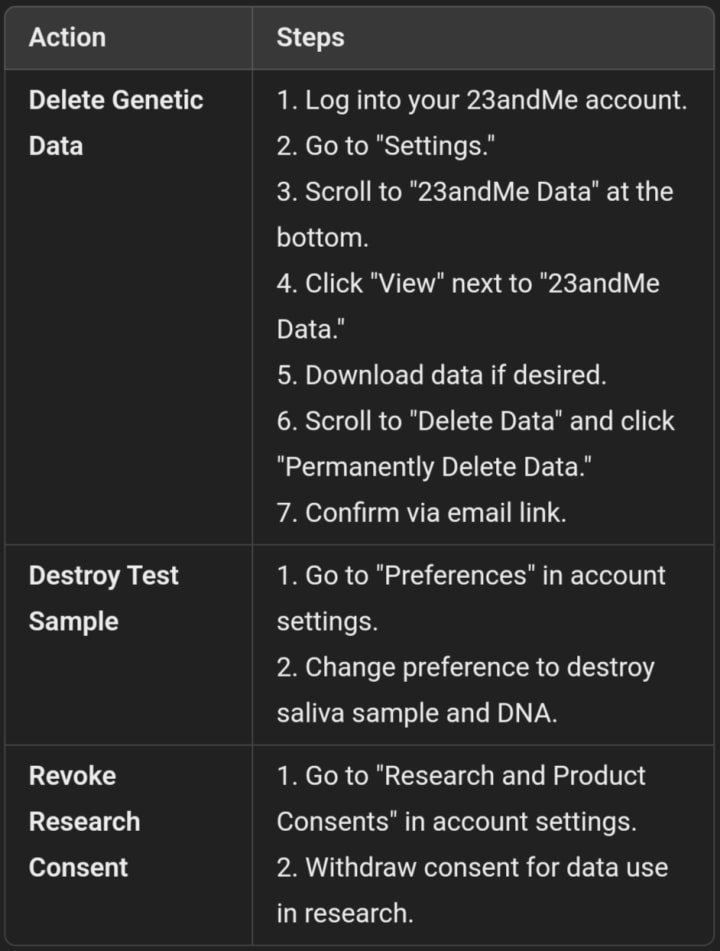
These steps ensure that customers can take control of their data, with the company confirming that data is permanently erased once the request is confirmed. A 23andMe spokesperson, Jimmy Asci, emphasized on Monday, March 24, 2025, that privacy remains a priority, with the company following strict security protocols and complying with state and federal regulations ([Jimmy Asci on X]
Implications and Future Outlook
The bankruptcy filing and privacy concerns highlight the importance of data security in the genetic testing industry. Customers are advised to consider their options, especially given the potential risks during bankruptcy proceedings. Deleting data offers peace of mind, though it’s a permanent action, meaning customers won’t access services again. It’s worth noting that other states may have similar privacy laws, but the alert is specific to California, reflecting its robust legal framework.
Wojcicki’s commitment to the company’s vision suggests a potential path forward, but the outcome of the restructuring process remains uncertain. For now, customers are encouraged to make informed decisions based on their privacy preferences and concerns.
Conclusion
This analysis shows that 23andMe’s bankruptcy filing is a pivotal moment, with significant implications for customer privacy and data security. The detailed steps for data deletion empower customers to protect their genetic information, aligning with regulatory advice amid financial uncertainty. As the company navigates its future, customers play a crucial role in safeguarding their data.
About the Creator
Retractable Fly Screens: A Modern Solution for Comfortable Living
In modern home design, comfort often depends on balancing indoor airflow with protection from outdoor elements. One of the simplest innovations that addresses this need is the use of Retractable Fly Screens for Doors & Windows. These systems allow homeowners to enjoy fresh air and natural light while preventing insects and debris from entering living spaces. Over the years, retractable fly screens have evolved from basic mesh barriers into versatile architectural features that enhance both functionality and aesthetics.
By charliesamuel4 days ago in 01
Why Specialized Pediatric EMR Systems Are Becoming Essential
Digital health technology is transforming healthcare systems worldwide, but pediatric care presents a unique set of challenges. From growth tracking and vaccination schedules to age-specific medication dosing, pediatricians need tools that are designed specifically for children rather than adapted from adult healthcare systems. As healthcare providers increasingly adopt digital solutions, specialized systems are becoming essential for efficient pediatric care.
By Steve Waugh7 days ago in 01




Comments
There are no comments for this story
Be the first to respond and start the conversation.