
BabylonJS vs ThreeJS: The Easiest to Learn in 2026
Which 3D framework gets you building faster? A developer's honest comparison of learning curves, performance, and production readiness in 2026.

If you're stepping into 3D web development in 2026, you've probably stumbled across two names that dominate the conversation: BabylonJS and ThreeJS. Both are powerful JavaScript libraries for creating stunning 3D graphics in the browser, but when it comes to learning them, building with them, and deploying them at scale, there are clear differences you need to understand.
Let me be direct. After working with both frameworks across multiple projects, I've watched developers of all skill levels tackle these tools. The results? Consistently different learning curves, performance profiles, and production outcomes.
The Learning Curve Reality
ThreeJS has been around longer, which means more tutorials, more Stack Overflow answers, and more community resources. Sounds perfect, right? Not exactly. The problem is that ThreeJS gives you incredible flexibility, but it comes at a cost. You're essentially building with lower-level primitives, which means more decisions, more setup, and more opportunities to get stuck.
BabylonJS takes a different approach. It's designed to be game-development friendly from the start, which means it includes more features out of the box. Need a physics engine? It's integrated. Want to add shadows? The system handles most of the complexity for you. This isn't about dumbing things down; it's about removing friction.
Starting Your First Project
Here's where the difference becomes obvious. With ThreeJS, your first simple scene requires you to understand renderers, scenes, cameras, and how they all connect manually. You'll write more boilerplate code before you see anything on screen.
BabylonJS gets you to that first rendered scene faster. The API is more intuitive for beginners because it uses gaming conventions that feel natural even if you haven't built games before. The documentation is structured as a learning path, not just a reference manual.
I tested this with a group of junior developers last year. Five tried ThreeJS first, five started with BabylonJS. The BabylonJS group had working prototypes within two days. The ThreeJS group? They spent three days just understanding the fundamentals before building anything meaningful.
Code Comparison: Your First Scene
ThreeJS requires:
- Manual scene creation
- Manual camera setup and positioning
- Manual lighting configuration
- Manual render loop implementation
- Separate controls library installation
BabylonJS provides:
- Integrated engine and scene creation
- ArcRotateCamera with built-in controls
- Light system included
- Render loop pre-configured
- MeshBuilder ready to use
The difference emerges in lines of code needed to achieve the same result.
Performance: What the Benchmarks Show
Performance matters, especially for production applications. Recent 2025 testing reveals interesting trade-offs between the two frameworks.
Bundle Size
ThreeJS ships at approximately 168KB minified and gzipped in its latest version. This minimal footprint makes it excellent for lightweight projects where initial load time is critical.
BabylonJS comes in at around 1.4MB minified and gzipped with all features included. However, it's modular, so you can import only what you need to reduce this significantly.
Runtime Performance
When testing identical 3D models with complex lighting:
ThreeJS delivers slightly lighter CPU usage but requires more manual optimization for complex scenes. It pushes rendering complexity to the GPU level, which works well for lightweight visualizations but can create CPU bottlenecks in scene-heavy applications.
BabylonJS uses more CPU for sophisticated scene management and frustum culling, but this results in more predictable frame times when dealing with thousands of objects. The built-in optimization tools reduce low-level performance debugging time.
For enterprise applications involving complex data visualization or CAD models, BabylonJS's engine-level tuning provides better stability during user interaction.
Documentation Makes the Difference
ThreeJS documentation is comprehensive but assumes you know what you're looking for. It's organized like a standard library reference, which works great when you understand the fundamentals.
BabylonJS documentation teaches you concepts progressively. It's the difference between a reference book and a textbook. For beginners, this structured learning path accelerates understanding significantly.
The BabylonJS Playground is another game-changer for learning. You can experiment with live code examples directly in your browser, see immediate results, and learn from hundreds of community examples. ThreeJS has similar tools, but they're not as centrally integrated into the learning experience.
Mobile and VR/AR Capabilities
Modern 3D web applications need to work seamlessly across devices, including mobile and immersive headsets.
Mobile Optimization
ThreeJS's smaller bundle size benefits mobile connections initially. However, BabylonJS provides better mobile optimization tools through its Inspector and built-in performance monitoring, which helps identify bottlenecks during development.
Both frameworks render efficiently on modern mobile devices when properly optimized, but BabylonJS's debugging tools make that optimization process more accessible for teams.
VR and AR Support
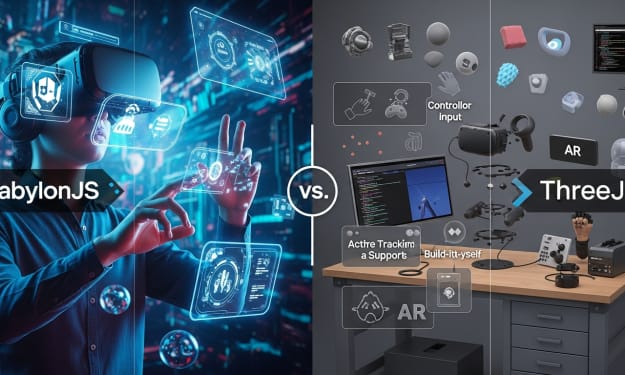
BabylonJS features a first-class, highly-integrated WebXR Manager that simplifies VR and AR setup dramatically. You can add VR support to a scene with minimal configuration, and the framework handles compatibility across different headsets automatically.
ThreeJS supports WebXR through external modules but requires more developer-implemented boilerplate code. If you're building AR or VR experiences, BabylonJS's integrated approach saves significant development time.
Team vs Solo Development
Your team structure should influence your framework choice.
ThreeJS suits:
- Solo developers who prefer building custom solutions from lightweight foundations
- Teams with strong graphics programming backgrounds
- Projects requiring highly customized, non-standard implementations
BabylonJS benefits:
- Teams needing consistent architecture across developers
- Organizations where integrated tools reduce decision paralysis
- Projects requiring rapid prototyping and iteration
For businesses working with development agencies—whether you're partnering with specialists in mobile app development in Maryland or elsewhere—BabylonJS's faster onboarding means quicker project starts and more predictable timelines.
Production and Enterprise Considerations
When building applications with 5+ year lifecycles, long-term stability matters.
Corporate Backing
BabylonJS is officially backed by Microsoft, which provides stability and consistent funding for active development. This corporate support ensures the framework won't be abandoned and maintains predictable API versioning.
ThreeJS is community-driven, which brings incredible flexibility and innovation but less guaranteed long-term stability for enterprise deployments.
Debugging and Developer Tools
BabylonJS ships with the Inspector, a powerful debugging tool that lets you select objects within your scene and inspect properties in real-time during development. The Node Material Editor accelerates material creation visually.
ThreeJS relies more on standard browser developer tools and community-built extensions. While powerful in experienced hands, this requires more expertise to use effectively.
When ThreeJS Makes Sense
I'm not saying ThreeJS is harder just to be difficult. If you're coming from a strong graphics programming background or you need absolute control over every rendering detail, ThreeJS might actually feel more natural. It's closer to raw WebGL, which some developers prefer.
ThreeJS also has a massive ecosystem. Nearly every imaginable problem has been solved by someone in the community. For artistic visualizations, experimental projects, or lightweight integrations into existing websites, ThreeJS's minimal approach provides creative freedom.
The framework excels when:
- Building simple data visualizations or interactive models
- Creating lightweight scenes without game-like features
- You prefer opting into features rather than disabling what you don't use
- You're comfortable wiring up physics, GUI, and interaction logic yourself
The 2026 Perspective
Here's what's changed recently. BabylonJS has invested heavily in developer experience. Their recent updates include better TypeScript support (though JavaScript works perfectly), improved debugging tools, and more comprehensive starter templates. They're clearly focused on making the onboarding experience as smooth as possible.
ThreeJS remains stable and reliable, with consistent updates from its passionate community. The learning curve hasn't fundamentally changed, but the ecosystem has grown richer with examples and libraries. It's still the same powerful, flexible, sometimes frustrating tool it's always been.
My Honest Recommendation
If you're learning 3D web development in 2026 and you don't have a graphics programming background, start with BabylonJS. You'll see results faster, which keeps motivation high. The concepts you learn transfer to ThreeJS if you switch later.
If you're already comfortable with graphics concepts or you specifically need the low-level control ThreeJS provides, then dive straight into ThreeJS. Just expect to spend more time learning before you start building.
For production applications with teams, BabylonJS's integrated tooling, corporate backing, and consistent API make it the safer choice for long-term projects.
For creative, experimental work where artistic control matters more than development speed, ThreeJS's flexibility and massive ecosystem provide more room for innovation.
The easiest to learn? BabylonJS wins this one clearly. But "easiest" doesn't always mean "best for your specific project." Consider your timeline, your team's background, project complexity, and deployment requirements.
The Bottom Line
Both frameworks are excellent. Your choice should depend on:
- Learning style: Structured tutorials (BabylonJS) vs flexible exploration (ThreeJS)
- Project requirements: Game-like features (BabylonJS) vs lightweight visualizations (ThreeJS)
- Team structure: Rapid onboarding (BabylonJS) vs experienced developers (ThreeJS)
- Timeline: How quickly you need working code
- Long-term support: Enterprise stability (BabylonJS) vs community innovation (ThreeJS)
In 2026, you can't go wrong with either option, but your learning journey, development experience, and production outcomes will definitely feel different.
Frequently Asked Questions
Which is easier for complete beginners: BabylonJS or ThreeJS?
BabylonJS is generally easier for complete beginners. It provides more built-in features like camera controls, lighting systems, and physics integration out of the box, which means less initial configuration. ThreeJS requires you to build more systems from scratch, which can be overwhelming when you're just starting out.
Does performance differ significantly between the frameworks?
Yes, but in nuanced ways. ThreeJS has a smaller initial bundle size (168KB vs 1.4MB), making it better for simple, lightweight applications. However, BabylonJS provides better scene management for complex applications with thousands of objects, resulting in more predictable frame rates under load. Choose based on your specific performance requirements.
Can I switch from BabylonJS to ThreeJS later?
Yes, but it requires a complete rewrite. The two frameworks have fundamentally different architectures, scene graphs, and APIs. However, the 3D concepts you learn in BabylonJS transfer well to ThreeJS, making the transition smoother than learning ThreeJS from scratch.
Which framework has better documentation?
BabylonJS has more comprehensive, tutorial-style documentation that guides beginners through concepts progressively. ThreeJS documentation is more reference-oriented, assuming you already understand 3D graphics fundamentals. Both have extensive examples, but BabylonJS's Playground makes learning more interactive.
Is ThreeJS better for small projects?
ThreeJS can be lighter for very simple visualizations since its core is minimal (168KB vs 1.4MB). However, BabylonJS is modular, so you can import only what you need. For quick prototypes without complex interactions, ThreeJS might load slightly faster, but the difference is often negligible for most projects.
Do I need to know TypeScript to use BabylonJS?
No. BabylonJS works perfectly with regular JavaScript. While it's written in TypeScript and offers excellent TypeScript support, you can use it with plain JavaScript without any issues. The TypeScript origins just mean better IDE support and type checking if you choose to use them.
Which is better for VR and AR development?
BabylonJS has significantly better integrated support for WebXR, with a built-in WebXR Manager that handles VR and AR setup with minimal configuration. ThreeJS supports WebXR through external modules but requires more manual implementation. If immersive experiences are your primary focus, BabylonJS saves considerable development time.
What about mobile app development?
Both frameworks work well for mobile web applications. ThreeJS's smaller bundle benefits initial load times, while BabylonJS provides better mobile optimization tools through its Inspector. Both render efficiently on modern mobile devices when properly optimized. The choice depends more on your development workflow than mobile-specific features.
About the Creator
Keep reading
More stories from Devin Rosario and writers in 01 and other communities.
BabylonJS vs ThreeJS Comparison for WebXR
WebXR is transforming how we experience the web, bringing virtual and augmented reality directly into browsers without apps or plugins. If you're building WebXR experiences, choosing between BabylonJS and ThreeJS isn't just about 3D graphics anymore. It's about how well each framework handles immersive experiences.
By Devin Rosario3 months ago in 01
Best Kotlin App Development Companies in USA (2026)
I reckon finding a solid dev team is harder than picking a winner at the races. You want speed, but you also want a build that does not fall apart when users flood in. That is why Kotlin app development companies are so busy lately.
By Samantha Blake5 days ago in 01



Comments
There are no comments for this story
Be the first to respond and start the conversation.