
Applications of Laser Marking in Key Industries
A technical overview of laser marking applications across regulated and high-precision industries


The use of laser marking is more widespread today than in the past. The technology creates permanent marks on materials through controlled heat application, removing surface layers, or creating color changes without physical contact. Laser marking replaced older methods like stamping, etching, and ink printing in many production environments.
The shift to laser happened because there was a need for precision that mechanical methods couldn’t (or struggled to meet. A laser beam focused to 0.01mm width creates detailed codes, logos, and identification marks on all types of surfaces, from soft plastics to hardened steel. Additionally, the marks stay readable even after years of use and exposure to chemicals and extreme temperatures.
Applications of Laser Marking
Laser marking needs are not constant across different industries:
Manufacturing
Production lines rely mostly on laser marking for traceability of parts. Different components are marked with unique identifiers that allow them to be tracked as they move along the production line.
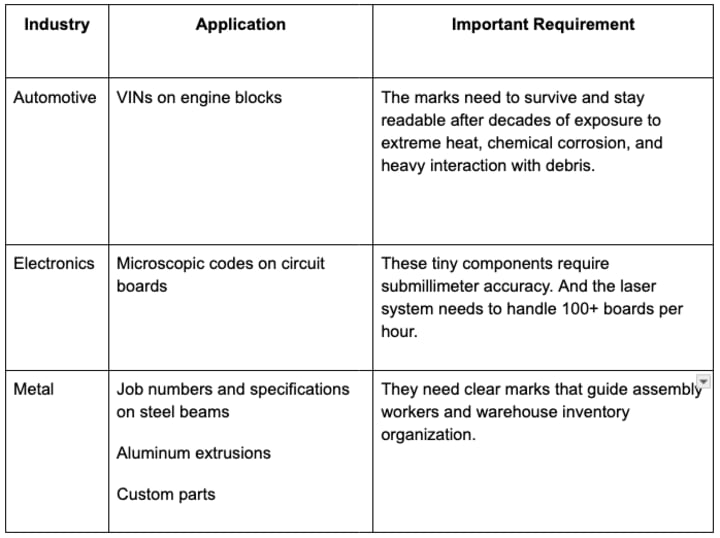
Fiber lasers handle these tasks because they generate marks that contrast well against bare metal surfaces, with the processing taking seconds per part compared to several minutes with mechanical engraving.
Medical Devices
Medical devices need laser marks that survive repeated sterilization. Think about a hospital environment: tools get disinfected several times a day, sometimes under extreme heat (134°C) or high-pressure steam. The marks made must remain legible, despite these cycles, and remain FDA-compliant.
Now, other types of laser markings done in the medical environment include:
- Implantable devices that need materials that work with the body’s chemistry.
- Titanium hip replacements and spinal hardware that must receive laser-etched lot numbers and manufacturing dates.
Such marks can create stress points that could lead to device failure. Therefore, depth and heat application require careful control. Medical device manufacturers test-marketed samples to ensure they maintain structural integrity under simulated body conditions.
Another challenge is marking lab equipment like glass beakers, pipettes, and culture dishes. They need identification marks that survive chemical exposure and dishwasher cleaning. UV lasers create these marks by altering the glass structure instead of removing material, thereby producing codes that remain stable in both acidic and basic solutions.
Electronics Industry
If you’ve looked closely at different consumer electronics, you’ll notice they have markers like model numbers, serial codes, and regulatory compliance symbols. For instance, phone manufacturers mark internal components with tracking codes (that must fit in spaces smaller than a grain of rice), which help with warranty claims and counterfeit prevention.
Another high-demand industry is connectors, with a single facility producing millions of USB ports, HDMI sockets, and power connectors monthly. Look closely at any of them, and you’ll notice details like a date code and production line identifier in marks measuring less than 1mm across. Plants use automated systems to position components, create marks, verify quality, and move parts to packaging without human intervention.
Aerospace
Most aircraft have operational lifespans of 20-30 years, which means the identification marks on different parts of the plane must remain readable for the same period. However, a challenge exists where parts like turbine blades operate at temperatures exceeding 1,000°C while spinning at thousands of RPM (rotations per minute). Additionally, the identification marks must withstand these conditions without creating weak points in the metal structure.
Aerospace manufacturers use laser marking applications that precisely control heat input. For perspective, the process creates marks 0.005-0.010 inches deep, which are deep enough for durability but shallow enough to avoid affecting component strength. Each part gets marked with codes that link to manufacturing records, inspection data, and maintenance history.
Other structural components, such as wing spars and fuselage sections, also need permanent identification. Usually, these parts undergo stress testing, corrosion treatment, and assembly operations at different facilities, and the marks help quality teams verify that components meet specifications and track any issues back to specific production batches.
Jewelry and Consumer Products
There is something many buyers do subconsciously: take a piece of jewelry and look for a code or branding to ‘verify' its originality. Jewelry makers use laser marking to add maker’s marks, metal purity stamps, and custom designs. The process works on gold, silver, platinum, and alternative metals without distorting delicate pieces.
With laser marking, engraving wedding bands with dates or initials takes under a minute per ring. For commercial pieces, manufacturers mark internal movements with brand logos and caliber numbers. Often, the marks fit in spaces that are barely visible to the naked eye, which is why you see sellers grab magnifying lenses. This level of detail helps authenticate genuine products and deters counterfeiting.
With consumer product companies, it’s more straightforward. They mark packaging with expiration dates, lot codes, and promotional information. Food manufacturers mark plastic bottles at speeds higher than 600 units per minute. The marks must contrast clearly against different surface colors and textures while meeting food safety regulations.
Material Compatibility
Operators need to know how different wavelengths interact with specific materials. For example:
Fiber Lasers
These lasers use a 1,064 nm wavelength that easily marks metals and many plastics. The beam energy transfers to these materials, creating marks through melting or oxidation.
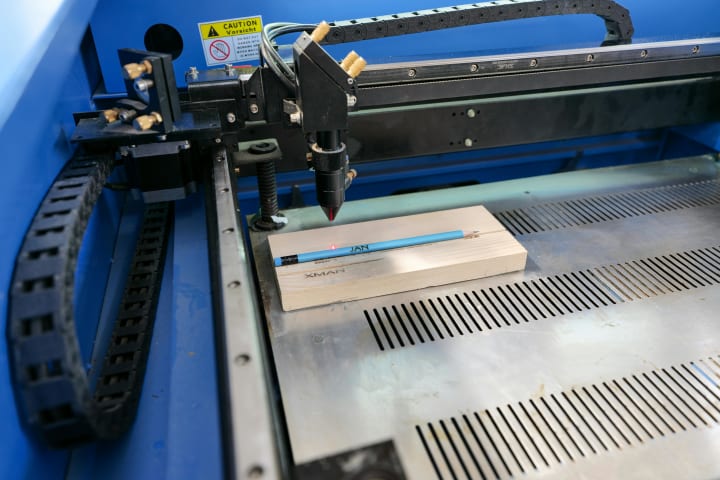
CO2 Lasers
These lasers use a 10,600 nm wavelength that works well on materials like wood, leather, paper, and acrylic, leaving marks without heavy burning.
UV Lasers
The 355nm wavelength is ideal for transparent materials and heat-sensitive plastics. The short wavelength breaks molecular bonds without generating heat, thereby preventing warping and discoloration in sensitive materials.
Quality Control
Today, marking systems connect to inspection equipment that checks each mark after it is created. They have cameras that capture the image of the completed marks. The system then compares the captured image against the listed specifications to determine whether it meets all acceptable parameters. This real-time monitoring means that defective products are flagged instantly and don’t go forward in production. On-site teams can also determine whether the equipment needs calibration.
The data gathered is used to track production metrics as the quality teams analyze consistency across shifts. Additionally, the process makes compliance with industry standards much easier, and the automated record-keeping satisfies audit requirements without manual logging.
Investing in Laser Marking Systems
Companies looking to add laser marking need to start by evaluating their volume requirements. Other important things to note when doing your evaluation include checking mark complexity, identifying required contrast levels, and seeing how the system integrates with existing production equipment. Choosing experienced providers means you get the configuration right from the word go and receive training and ongoing support throughout your journey.
About the Creator
Aaron Smith
Aaron is a content strategist and consultant in support of STEM firms and medical practices. He covers industry developments and helps companies connect with clients. In his free time, he enjoys swimming, swing dancing, and sci-fi novels.
Keep reading
More stories from Aaron Smith and writers in 01 and other communities.
How ERP Can Improve Your Sales Forecasting
Let’s face it, sales forecasting usually means a fair amount of guesswork. You’re looking at last quarter’s results, trying to estimate a new marketing push, while keeping an eye on a competitor’s unexpected sale. You bring all this data together into a big spreadsheet and hope the number you arrive at is somewhere in the ballpark.
By Aaron Smith4 months ago in 01



Comments
There are no comments for this story
Be the first to respond and start the conversation.