
Apple’s M5-Powered MacBook Pro Ushers in a New Era of On-Device AI
A silent revolution in personal computing is unfolding one where artificial intelligence no longer lives in the cloud, but right inside your laptop.

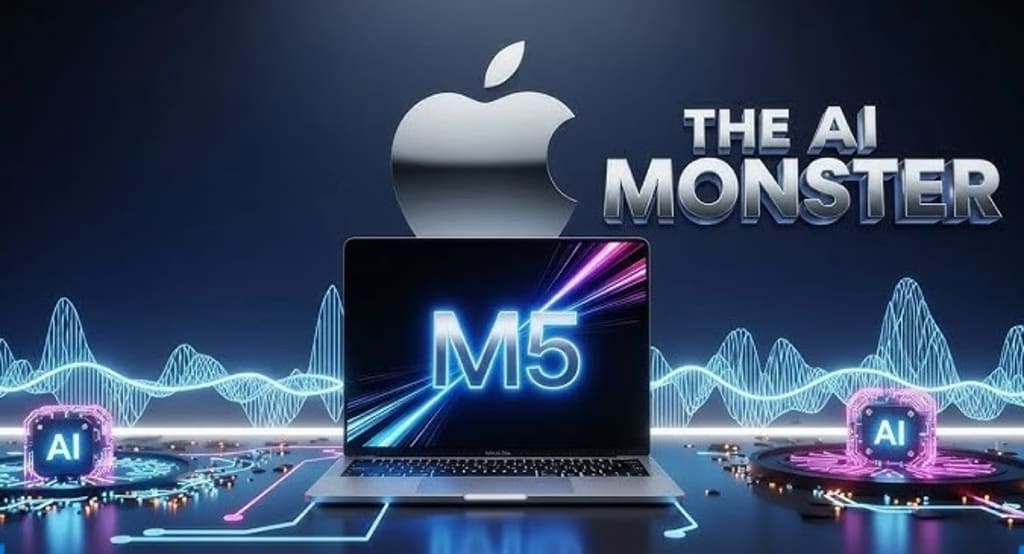
How Apple’s New M5-Powered 14-Inch MacBook Pro Is Redefining On-Device AI Productivity
A silent revolution in personal computing is unfolding one where artificial intelligence no longer lives in the cloud, but right inside your laptop.
When Apple unveiled its latest 14-inch MacBook Pro on October 15, 2025, it wasn’t just another shiny gadget launch. It marked a profound shift in how technology companies envision the future of AI computing.
At the center of the announcement lies Apple’s new M5 chip, a silicon marvel designed to bring advanced artificial intelligence processing on device making AI tasks faster, more private, and less dependent on the cloud.
This development isn’t only a win for Apple’s loyal customers. It signals a transformation that could redefine how creative professionals, developers, and enterprises use technology over the next decade.
The Rise of On-Device Intelligence

For years, AI models from chatbots to image generators have been trained and executed in powerful cloud data centers. That dependency has often meant slower response times, recurring subscription costs, and potential privacy concerns.
Apple’s M5 aims to change that.
According to Apple’s October 2025 press release, the chip includes an enhanced Neural Engine that delivers up to 3.5× faster AI performance compared to the previous generation. What makes this more significant is the ability to run large language models (LLMs) and image-generation tools directly on the laptop, without relying on external servers.
Imagine a video editor generating high-quality B-roll using AI while on a flight, or a researcher analyzing complex data in the field without an internet connection. The M5’s capabilities make such scenarios not only possible but practical.
Empowering the Next Generation of Creators
Creative professionals stand to benefit the most from this paradigm shift.
The new MacBook Pro allows real-time AI-driven editing, image synthesis, and 3D rendering processes that traditionally required heavy cloud infrastructure or desktop workstations.
Apple has also introduced optimized APIs for developers, allowing creative software like Final Cut Pro and Logic Pro to leverage local AI cores more efficiently. Tasks such as voice isolation, scene recognition, or content-aware fill can now run instantly and offline.
In essence, creators are gaining back speed, privacy, and control three things often compromised when working with cloud-based AI.

The Big Shift: Local AI Becomes Practical
- The new M5 chip includes a Neural Accelerator in every core, allowing on-device AI tasks to run up to 3.5× faster compared to previous Apple chips.
- This opens up new possibilities: running large language models (LLMs), generating images, doing video enhancements all without constant internet or server support.
- For professionals, that means greater privacy, lower latency, and greater autonomy. You no longer need to rely on remote cloud servers for heavy AI tasks.
The Implications for Work & Productivity
1. Creative Tools Reimagined
Designers and media professionals can now run AI-powered video editing, image synthesis, or 3D rendering in real time on their laptops.
2. Data & Analysis On the Fly
Analysts can deploy models locally on datasets, doing quick iterations without waiting on server queues.
3. Edge Use Cases & Field Work
In places with limited or unstable internet, professionals (engineers, surveyors, researchers) can still leverage AI tools on site, offline.
4. Rethinking Cloud Dependence
Organizations may shift strategies: less reliance on cloud infrastructure, more hybrid architectures where powerful endpoints carry heavier loads.
Challenges & Considerations
- Thermal & power constraints: Running AI locally uses more power and generates more heat; managing these will be critical.
- Model size & memory limits: Some AI models are huge; fitting them efficiently on-device without performance tradeoff is nontrivial.
- Security & updates: Ensuring AI models are secure, updatable, and managed properly on many devices is an operational challenge.
- Ecosystem support: Software tools, libraries, and frameworks must adapt for seamless deployment across devices and cloud.
About the Creator
Farooq Hashmi
Thanks for reading! Subscribe to my newsletters.
- Storyteller, Love/Romance, Dark, Surrealism, Psychological, Nature, Mythical, Whimsical
Keep reading
More stories from Farooq Hashmi and writers in 01 and other communities.
The Role of AI Agents in Modern Enterprise Automation Strategies
AI is transforming how work gets done in enterprises, but it won’t replace humans outright. Instead, employees who leverage AI effectively will outpace those who don’t. Modern automation has evolved beyond simple scripts and scheduled tasks, introducing intelligent software capable of making decisions, interacting with systems, and completing meaningful work independently.
By Swiftproxy5 days ago in 01
The Hidden Technology That Powers Every Pickup and Delivery Request
In the modern digital economy, convenience has become one of the most important factors influencing customer behavior. People expect services to be fast, reliable, and accessible at the touch of a button. Pickup and delivery platforms have emerged as a powerful solution that connects businesses with customers in real time, making the movement of goods easier than ever before. Whether it is food, groceries, parcels, or retail items, these platforms have transformed the way people send and receive products.
By Nayel Basim Al Shehhi3 days ago in 01



Comments
There are no comments for this story
Be the first to respond and start the conversation.