
AI Server Market Size & Forecast 2025–2033
Explosive Growth of AI Infrastructure Redefines the Global Server Landscape


AI Server Market Overview
The AI Server Market is undergoing one of the most dramatic transformations in modern technology history. According to Renub Research, the global AI server market is expected to surge from US$ 126.34 billion in 2024 to an astonishing US$ 1,848.08 billion by 2033, expanding at a robust CAGR of 34.73% during 2025–2033.
This exponential growth reflects the central role that artificial intelligence now plays across industries. From predictive healthcare and autonomous vehicles to financial risk modeling and personalized e-commerce, AI workloads demand immense computational power, low latency, and scalable architectures. Traditional servers are no longer sufficient—AI-optimized servers equipped with GPUs, ASICs, and FPGAs have become the backbone of digital transformation worldwide.
AI servers are purpose-built systems designed to support machine learning (ML), deep learning (DL), and large language models (LLMs). They feature high-performance accelerators, massive memory bandwidth, ultra-fast networking, and advanced cooling technologies to handle energy-intensive workloads efficiently. As organizations race to operationalize AI at scale, demand for these servers continues to accelerate across both cloud and on-premises environments.
Why AI Servers Are Becoming Mission-Critical
AI has moved beyond experimentation into mission-critical business operations. Enterprises are embedding AI into customer service automation, fraud detection, predictive maintenance, supply-chain optimization, and real-time decision-making. These applications require servers capable of parallel processing, high-speed data throughput, and continuous availability.
Cloud service providers and hyperscale data centers are the largest adopters of AI servers, offering AI-as-a-Service (AIaaS) to enterprises of all sizes. At the same time, edge computing is expanding the AI server footprint beyond centralized data centers, enabling real-time analytics closer to data sources such as factories, hospitals, retail stores, and smart cities.
Hybrid and multi-cloud strategies further amplify demand. Organizations increasingly require flexible AI server infrastructures that seamlessly integrate public cloud platforms with on-premises systems while ensuring data sovereignty, security, and regulatory compliance.
Key Factors Driving AI Server Market Growth
1. Rapid AI Adoption Across Industries
Artificial intelligence adoption is accelerating across healthcare, BFSI, retail, automotive, telecommunications, manufacturing, and government sectors. Applications such as medical imaging analysis, algorithmic trading, recommendation engines, autonomous driving, and natural language processing require massive computational resources.
AI servers are specifically engineered to process large datasets and complex algorithms with minimal latency. As AI becomes embedded in core business processes, organizations are upgrading legacy infrastructure and deploying dedicated AI servers at scale, significantly boosting market demand.
2. Expansion of Cloud and Hyperscale Data Centers
The global expansion of cloud infrastructure is a primary catalyst for AI server adoption. Hyperscalers continuously invest billions of dollars in AI-optimized data centers to support growing customer workloads.
AI servers enable faster model training, scalable inference, and efficient data handling—key requirements for cloud-based AI services. As enterprises migrate AI workloads to the cloud for flexibility and cost efficiency, cloud providers are expanding their AI server fleets, driving sustained market growth.
3. Advancements in AI Hardware and Server Architecture
Ongoing innovation in AI hardware is reshaping server capabilities. GPUs, TPUs, NPUs, and custom ASICs are dramatically accelerating AI workloads. Combined with high-bandwidth memory, advanced interconnects, modular server designs, and liquid cooling systems, modern AI servers deliver superior performance and energy efficiency.
These advancements are reducing total cost of ownership over time, making AI servers more accessible to mid-sized enterprises and startups. As hardware continues to evolve, adoption is expected to broaden further across industries.
Challenges Facing the AI Server Market
High Deployment and Operational Costs
AI servers require significant upfront investment due to specialized processors, advanced memory, high-speed networking, and cooling infrastructure. Ongoing costs related to power consumption, system maintenance, and skilled personnel further strain IT budgets—particularly for small and mid-sized organizations.
As a result, some enterprises delay large-scale deployments or rely on shared cloud resources and hybrid models to manage costs.
Data Security and Regulatory Compliance
AI servers process vast volumes of sensitive data, making them attractive targets for cyberattacks. Ensuring data security requires robust encryption, access controls, and continuous monitoring, increasing complexity and cost.
Additionally, organizations must comply with evolving regulations such as GDPR, HIPAA, and industry-specific AI governance frameworks. Navigating these regulatory environments can slow deployments and add operational challenges, particularly for multinational enterprises.
AI Server Market Overview by Region
North America
North America leads the global AI server market, driven by strong R&D investments, early technology adoption, and the presence of major cloud providers. The United States dominates regional demand, supported by enterprise digitization, government AI initiatives, and extensive data center construction.
Europe
Europe represents a steadily growing market, with strong adoption across finance, healthcare, manufacturing, and public services. Strict data protection regulations increase demand for secure, compliant AI server deployments, particularly on-premises and hybrid models.
Asia Pacific
Asia Pacific is the fastest-growing region, fueled by rapid digitalization, expanding cloud infrastructure, and strong government support for AI initiatives. China, Japan, South Korea, and India are emerging as major AI server markets, driven by smart manufacturing, fintech, and telecom expansion.
Latin America, Middle East & Africa
These regions are emerging markets with growing investments in digital infrastructure and smart city projects. Countries such as the UAE and Saudi Arabia are positioning themselves as regional AI hubs through strategic government initiatives and data center investments.
Country-Level Market Highlights
United States
The U.S. remains the global benchmark for AI server adoption, supported by hyperscalers, advanced research institutions, and strong private-sector investment. Healthcare, defense, and finance sectors drive large-scale deployments, while edge AI and data center expansion sustain long-term growth.
United Kingdom
The UK AI server market benefits from government funding, enterprise AI adoption, and academic-industry collaboration. Demand is rising for AI servers supporting automation, analytics, and natural language processing, particularly within regulated industries.
India
India’s AI server market is expanding rapidly due to digital transformation initiatives, a thriving startup ecosystem, and increasing AI adoption in fintech, healthcare, agriculture, and education. While cost and infrastructure challenges remain, government support and local manufacturing initiatives strengthen long-term growth prospects.
United Arab Emirates
Driven by the UAE AI Strategy 2031, the country is investing heavily in AI-enabled infrastructure, smart cities, and data centers. Strong government backing and sustainability-focused deployments position the UAE as a regional AI infrastructure hub.
Recent Developments in the AI Server Industry
In May 2025, NVIDIA Corporation introduced the DGX Spark and DGX Station systems, featuring high-speed networking and multi-instance GPU technology to support scalable AI workloads.
During the same period, Dell Inc. launched next-generation AI servers powered by advanced NVIDIA architectures, offering both air-cooled and liquid-cooled configurations to accelerate AI model training.
These innovations highlight the intense competition and rapid technological evolution shaping the AI server ecosystem.
AI Server Market Segmentation
By Type
GPU-based Servers
FPGA-based Servers
ASIC-based Servers
By Cooling Technology
Air Cooling
Liquid Cooling
Hybrid Cooling
By Form Factor
Rack-mounted Servers
Blade Servers
Tower Servers
By End Use
IT & Telecommunication
BFSI
Retail & E-commerce
Healthcare & Pharmaceutical
Automotive
Others
Competitive Landscape
The AI server market is highly competitive, characterized by rapid innovation, strategic partnerships, and continuous product launches. Key players include Cisco Systems, Inc., IBM Corporation, HP Development Company, L.P., Huawei Technologies Co., Ltd., Fujitsu Limited, Lenovo Group Limited, Super Micro Computer, Inc., and ADLINK Technology Inc..
Final Thoughts
The AI Server Market is entering a transformative decade. With market value projected to exceed US$ 1.8 trillion by 2033, AI servers are becoming the digital backbone of global innovation. While high costs and regulatory complexities pose challenges, relentless advancements in hardware, cooling, and server architecture continue to unlock new opportunities.
As artificial intelligence reshapes industries and economies, investment in scalable, secure, and energy-efficient AI server infrastructure will define competitive advantage. Organizations that align early with this technological shift are poised to lead the next era of data-driven growth and intelligent automation.
About the Creator
jaiklin Fanandish
Jaiklin Fanandish, a passionate storyteller with 10 years of experience, crafts engaging narratives that blend creativity, emotion, and imagination to inspire and connect with readers worldwide.
Keep reading
More stories from jaiklin Fanandish and writers in 01 and other communities.
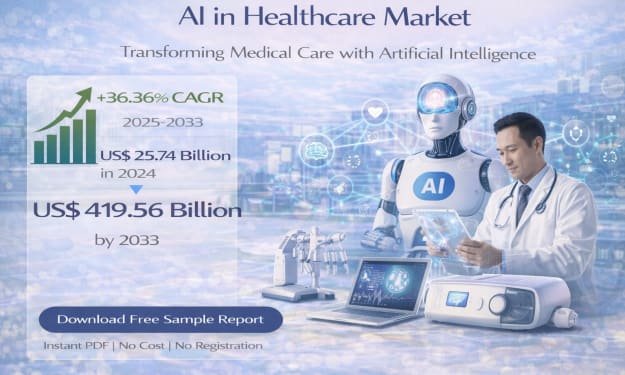
AI in Healthcare Market Size and Forecast 2025
AI in Healthcare Market Snapshot According to Renub Research, the AI in Healthcare Market is poised for extraordinary expansion. The market is expected to grow from US$ 25.74 billion in 2024 to US$ 419.56 billion by 2033, registering a remarkable CAGR of 36.36% from 2025 to 2033.
By jaiklin Fanandish15 days ago in 01
What Are The Worst Subreddits That Reddit Still Hasn't Banned?
What are the worst subreddits that Reddit still hasn't banned? Reddit is a social news aggregation platform that came into being in 2005. Ever since its creation, millions of users have created their own subreddits where they share their interests in the form of posts, pictures, or videos.
By Intelligent Creator5 days ago in 01
Evangeline Lilly’s Scary Fall Leaves Her With Brain Damage
The Day That Changed Everything In May 2025, Lilly was enjoying the outdoors in Hawaii when something unexpected happened. She fainted while walking on the beach-a sudden blackout she later said wasn't entirely unfamiliar-and fell face-first onto a rock. The impact was significant enough to leave her with cuts and bruises, but at first the full extent of the injury was unclear.
By iftikhar Ahmad7 days ago in 01


Comments
There are no comments for this story
Be the first to respond and start the conversation.