
AI in Customer Service | How AI is Redefining Customer Support
AI Customer Service

Did you know 62% of customers prefer to use AI if it means getting faster service? Yes, it is true.
Imagine, you’ve just ordered groceries online, and one item arrives damaged. You reach out to customer support and are immediately connected to an AI agent. It recognizes your order details but also offers a refund or replacement, in under one minute. No holding the line. No repeating your issue three times. Relaxing, right?
That’s not the future. That’s today.
But while AI delivers speed and scale, the human touch remains irreplaceable because great service is still about empathy when it matters most. And empathy only humans do, AI does not empathize with you.
As expectations for instant support grow, businesses are rapidly turning to AI customer service to stay ahead.
In this blog, we’ll talk about how AI customer service works, its benefits, and real-world examples of brands doing it right. Whether you're exploring AI for customer service or planning to scale it, this guide covers everything. Let’s get started!
What is AI in Customer Service?
AI in customer service involves using artificial intelligence technologies such as chatbots, virtual assistance, and automated self-service systems to improve customer interactions.
By handling repetitive tasks and offering 24/7 support, AI speeds up response times, reduces the burden on human agents, and helps to deliver high-quality service.
How to Use AI to Improve Customer Support:
Here’s how you see that businesses can effectively use AI for customer service:
- Deploy AI Chatbots on Your Website or App
Use Case: You sometimes see on other sites that they implement the chatbot. Chatbots automate the responses to FAQs, track orders, handle cancellations, give updates to customers, and schedule appointments.
How It Helps:
Instead of waiting for an agent, customers get instant responses. For example, a retail website can use a chatbot to answers the customers simple queries like “Where is my order?” and instantly show shipping status from the backend system.
2. Automated Ticketing & Case Routing
Use Case: AI can automatically understand a customer’s issue and route it to the correct department. This ensures the customer’s call is forwarded to the right agent at the right time, thus saving a lot of time.
How It Helps:
Reduces human error in ticket assignments, increases resolution speed, and ensures urgent issues get prioritized. For example, if a customer types “My account is locked,” AI can classify it as a high-priority login issue and assign it to the tech support team
3. Voice AI in Call Centers
Use Case: AI listens to customer calls in real-time, detects keywords, and either responds with pre-programmed answers or assists the human agent.
How It Helps:
Reduces call handling time by suggesting answers on-screen to agents. Some systems even alert supervisors if customer frustration is detected.
4. AI-Driven Knowledge Base Search
Use Case: AI understands the customer’s question and instantly gives the most relevant answer from knowledge base software going beyond simple keyword matching. This allows customers and agents to find clear, accurate information quickly, improving resolution times and reducing back-and-forth.
How It Helps:
Improves self-service success rate and helps agents quickly locate the right answer. AI understands context, so instead of just finding articles with the word "refund," it knows you’re asking how to process one.
Key Benefits of AI Customer Service
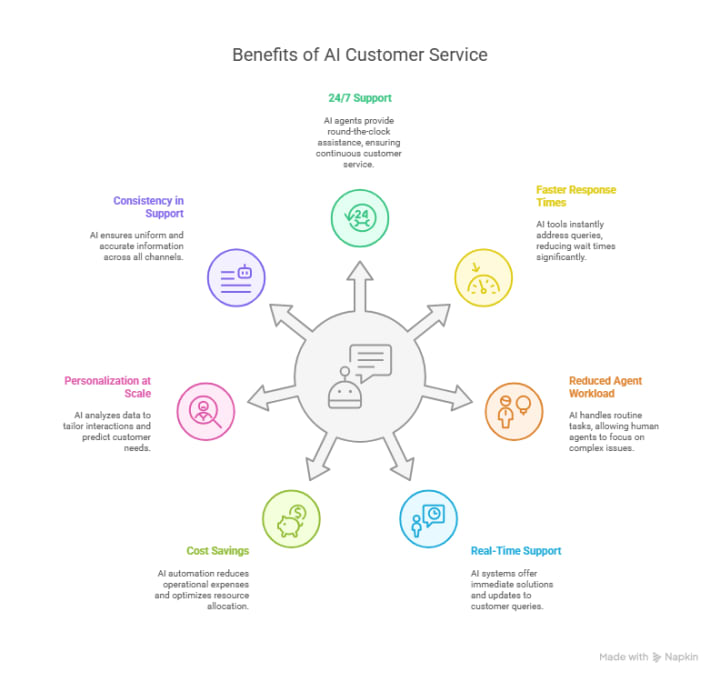
- 24/7 Customer Support
AI agents work 24/7, handling repetitive queries instantly so customers always get quick help even at night or on weekends. With the help of AI agents, human agents focus more on complex things, instead of focusing more on daily activities or repetitive tasks.
- Faster Response Times
No more frustrating wait times. AI tools can instantly respond to basic queries, cutting down response times from minutes to mere seconds. Quick answers mean happier, more loyal customers.
- Reduced Agent Workload
AI handles repetitive, time-consuming questions like order tracking, password resets, return policies, so that human agents have freedom to focus on complex, high-value interactions that require critical thinking and empathy.
- Real-Time Support
AI systems process customer queries instantly, offering real-time solutions and updates. Whether it’s a chatbot answering a simple question or predictive support suggesting solutions, customers experience faster resolution without long delays.
- Cost Savings
Hiring and training support teams can be expensive. AI reduces operational costs by automating common tasks, handling large volumes of queries efficiently, and allowing you to optimize their human resources for more impactful work.
- Personalization at Scale
AI doesn’t just answer questions, it remembers you. By analyzing customer behavior, preferences, and history, AI can personalize interactions, recommend solutions, and even predict future needs.
4 Examples of AI in Customer Service
1. Domino’s Pizza – Order, Track, Repeat
You go to the Domino’s website just to reorder your favorite pizza and there’s Dom, their AI chatbot, already suggesting your usual, tracking your delivery, and even throwing in a deal you didn’t know about. No wait, no hassle. Just pizza, fast and hot.
2. AirAsia – Flight Changes Without the Wait
Need to change flight? Instead of calling a helpline, AirAsia’s virtual assistant, AVA, handles everything, from rescheduling to refunds, right on the website. It’s fast, available 24/7, and speaks your language. You get done in minutes, not hours.
3. H&M – Your Personal Style Buddy
While browsing H&M online, their AI picks up on your favorite styles via history and starts suggesting full outfits that match. It’s like having a personal stylist helping you shop, without the awkward small talk.
4. Spotify – Music That Just Gets You
You listen to one chill playlist, and next thing you know, Spotify’s “Made for You” mixes are spot on. It's AI learns what you like, your mood, and even the time of day to serve up the perfect soundtrack.
Key Things to Consider When Implementing AI-Powered Customer Service
1. Train AI on Real Conversations, Not Just Sample Scripts
Your AI will only be as helpful as the data it's trained on. Use real customer interactions such as chat logs, support emails, call transcripts to help it understand how people communicate. That includes typos, slang, emotional language, and multi-intent queries.
Why it matters: If your customers type “can’t log in + password reset not working,” AI needs to know how to parse that. Real-world data gives AI the depth it needs to respond accurately.
2. Start Small, Then Scale Thoughtfully
Don’t launch AI across all support channels at once. Begin with one focused use case, like order tracking or appointment scheduling. Test it, improve it, and only then expand to other areas like product recommendations, billing queries, or returns.
Why it matters: A phased rollout gives you time to refine your AI based on customer feedback, avoiding large-scale failures or negative experiences.
3. Plan Your Budget and Internal Investment
AI isn’t plug-and-play. Whether you build it in-house or partner with a platform, consider the cost of training data, integration with your systems (CRM, helpdesk, knowledge base), ongoing updates, and support.
Why it matters: A realistic budget helps avoid under-delivering. Treat AI as a strategic investment, not just a cost-saving tool.
4. Ensure Human Handover is Always an Option
Even the smartest AI will encounter situations it can’t resolve. Always make it easy for customers to reach a human agent when needed, ideally without repeating themselves.
Why it matters: Customers don’t want to feel trapped in a chatbot loop. A seamless handover keeps frustration low and satisfaction high.
5. Prioritize Data Security and Privacy Compliance
AI will handle sensitive customer information from account details to personal identifiers. Ensure your system is compliant with data regulations (like GDPR or CCPA) and that it encrypts, stores, and accesses data securely.
Why it matters: Trust is everything in customer service. A data breach caused by poorly managed AI can damage your brand and lead to legal trouble.
6. Ensure You Have the Right Internal Expertise
AI implementation needs alignment between CX, IT, product, and even legal teams. If your team lacks in-house expertise, consider working with trusted vendors who specialize in AI for customer service.
Why it matters: AI is not “set it and forget it.” It needs constant monitoring, optimization, and alignment with your evolving support strategy.
7. Track, Learn, and Improve Constantly
Once deployed, use KPIs like first response time, resolution rate, bot deflection rate, and customer satisfaction (CSAT) to measure success. Also analyze common failure points—where customers ask for a human or abandon the conversation.
Why it matters: AI improves over time, but only if you’re actively learning
What is the Future of AI Customer Service?
The future isn’t just about AI answering questions, it’s about anticipating them. Predictive AI will soon resolve issues before customers even report them. Imagine getting a message from your airline saying, “Your flight is delayed, and we’ve rebooked you.”
As AI customer service continues to evolve, it’ll merge deeper with CRM tools, personalize interactions based on customer history, and even use emotional AI to respond empathetically
To Sum It Up
AI customer service is no longer an option; it’s a competitive advantage. With faster resolutions, smarter routing, and 24/7 availability, AI-powered customer support not only meets expectations but exceeds them.
Whether you're a growing startup or a large enterprise, implementing AI in customer service can redefine how you connect with customers making every interaction feel smarter, faster, and more human especially when backed by strong knowledge management for customer service.
About the Creator
Knowmax
Knowmax is an AI Guided Knowledge Management Platform. We empower your CX teams to deliver mistake-proof service across touchpoints with contextual and actionable knowledge.
Why Software Testing Services Need Manual and Load Testing?
In today’s digital-first world, software is expected to work flawlessly from the first click to the millionth user. Whether it’s a customer-facing application, an internal enterprise system, or a cloud-based platform, users have little tolerance for bugs, slow performance, or unexpected crashes. This is why Software Testing Services are no longer a final checklist item—they are a core part of building reliable, scalable products.
By Jane Smith7 days ago in 01
iPhone 18 Pro Leaks Drama: The Dynamic Island Confusion Explained
The iPhone 18 Pro is already stirring up controversy, and it all started with a viral video from FPT. The renders showed off what looked like a major display redesign—one where the Dynamic Island had been shifted over to the left side of the screen. Unsurprisingly, the internet went into meltdown mode.
By Info Post Gate2 days ago in 01
One Hard Thing
Stop me if you’ve heard this one before: You have the number, you know your schedule- you’ve even picked out the perfect day and time to make this appointment. Shoot, you’ve even picked out alternative days and times just in case their schedules can’t accommodate you!
By Taylor Rigsby2 days ago in Motivation



Comments
There are no comments for this story
Be the first to respond and start the conversation.