
AI-Driven ERP Systems
A New Revolution in Business Processes


Enterprise Resource Planning (ERP) systems have been the operational backbone of businesses for decades. However, by 2025, these systems have evolved from passive tools that merely store and report data into proactive, intelligent, and strategic decision-making partners through artificial intelligence (AI) integration. AI has become the fundamental force shaping the future of ERP, ushering in a new era in the digital transformation journey of businesses. This transformation represents not just a technological update, but a radical paradigm shift in the way business is conducted.
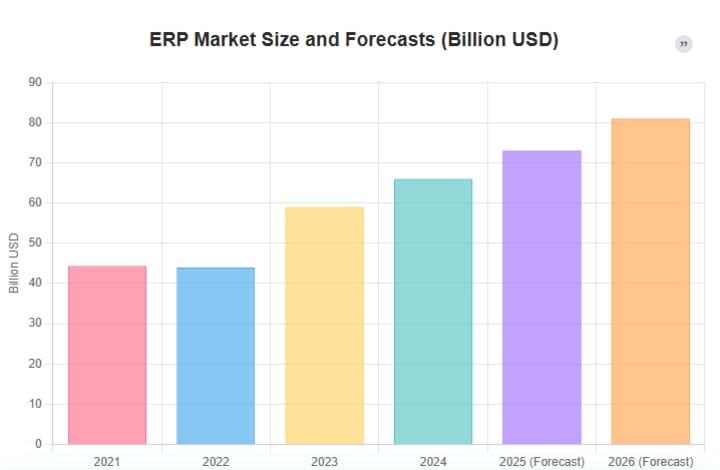
Market data confirms this revolution. The global ERP market, which reached a size of $66 billion in 2024, is expected to grow to $73 billion in 2025. One of the most significant driving forces behind this growth is the increasingly deep integration of AI capabilities into ERP solutions. In this review, we will explore in detail what AI-driven ERP systems mean, the tangible benefits they offer to businesses, their practical application areas, the challenges faced, and what the future holds.
From Traditional ERP to Intelligent ERP: The Foundations of Evolution
Traditional ERP systems aim to eliminate silos by consolidating data from different departments such as finance, supply chain, manufacturing, and human resources under a single roof. However, these systems are often limited to reporting historical data and have a reactive structure. Users need to perform manual data entry, interpret this data to derive meaningful insights, and make strategic decisions. This leads to both time loss and human-induced errors.
AI-powered ERP, on the other hand, completely changes this equation. By using technologies like machine learning (ML), natural language processing (NLP), and big data analytics, ERP systems are no longer just processing data but are transforming into systems that learn from data, provide future predictions, and can even make autonomous decisions. In other words, AI is transforming ERP from a passive data library into a "decision partner" that actively helps the business achieve its strategic goals.
Key Benefits and Strategic Value of AI-Powered ERP
Beyond adding an abstract layer of "intelligence" to ERP systems, AI integration provides businesses with measurable and tangible benefits. These benefits span a wide range, from operational efficiency to strategic competitive advantage.
Operational Efficiency and Automation
One of the most significant contributions of AI is the automation of repetitive and time-consuming tasks. Manual processes such as invoice processing, data entry, and order management are performed faster and more accurately without human intervention, thanks to AI algorithms. This automation allows employees to dedicate their time to more strategic and value-added work, while reducing operational costs and minimizing human errors.
Enhanced Decision-Making and Predictive Analytics
Perhaps the most revolutionary impact of AI is its transformation of decision-making processes. Unlike traditional reporting, predictive analytics models analyze historical data and external factors (market trends, seasonality, social media movements, etc.) to provide accurate future forecasts. This enables businesses to:
Demand Forecasting: More accurately predict future sales to optimize inventory levels and improve production planning.
Cash Flow Management: Forecast future cash flow to build financial planning on a more solid foundation .
Risk Management: Proactively take measures by detecting potential disruptions in the supply chain or anomalies in financial records in advance.
This capability transforms ERP from a reactive system into a proactive strategic tool.
Process Optimization and Cost Reduction
AI algorithms are far more effective than the human eye at identifying inefficiencies and bottlenecks in business processes. In areas such as optimizing supply chain routes, ensuring the most efficient use of resources, or identifying waste in production processes, AI provides concrete recommendations that directly reduce costs.
Improved User Experience
Thanks to Natural Language Processing (NLP) technology, users can now chat with ERP systems instead of getting lost in complex menus. AI-powered chatbots and virtual assistants that operate with simple commands like "Show this month's sales report" make the system easier to use and more accessible for everyone. This increases user adoption and reduces training costs .
Application Areas by Department: Practical Examples
The integration of AI into ERP creates tangible benefits in every department of the business. Here are some practical application examples:
Finance and Accounting: AI transforms the finance department into a center for automation and foresight. As in Oracle's ERP solutions, AI and machine learning are used to automate compliance processes like segregation of duties (SoD), prevent fraud by detecting suspicious transactions, and accelerate month-end closing processes.
Supply Chain Management (SCM): AI makes the supply chain more flexible, transparent, and efficient. It optimizes delivery routes by analyzing real-time traffic, weather, and supplier performance data, reduces inventory costs with demand forecasting, and prepares businesses by generating early warnings for potential supply disruptions .
Human Resources (HR): AI tools like Copilot in Microsoft Dynamics 365 Human Resources significantly simplify HR processes. Tasks such as analyzing hundreds of resumes in seconds to identify the most suitable candidates, automating routine payroll and leave processes, and recommending personalized training programs for employees are undertaken by AI .
Sales and Customer Service: AI provides sales teams with insights on which customers to focus on and identifies cross-selling and up-selling opportunities. In customer service, AI-powered chatbots answer frequently asked questions 24/7, increasing customer satisfaction and reducing the workload of the support team .
Challenges, Risks, and Considerations
Despite the immense potential offered by AI-powered ERP systems, the implementation of this technology also brings a series of challenges. It is critically important for businesses to take careful steps on this transformation journey.
The integration of artificial intelligence into ERP systems is still in its infancy, but its potential is enormous. However, to benefit from this technology, risks such as data privacy, transparency, bias, and security must also be addressed.
Data Quality and Infrastructure: AI algorithms operate on the "garbage in, garbage out" principle. An AI model fed with incorrect, incomplete, or poor-quality data will produce wrong predictions and flawed decisions. Therefore, having clean, structured, and sufficient data is a prerequisite for successful integration.
High Cost and Complex Integration: Implementing an AI-powered ERP program can require a significant initial investment and complex integration processes, especially when modernizing existing legacy systems.
Data Security and Ethical Concerns: AI systems require large amounts of sensitive data for processing. Ensuring the security of this data and protecting it against cyberattacks and data breaches is vital. Furthermore, the inheritance or amplification of existing biases in the data used by AI models can lead to unfair and discriminatory outcomes. These ethical issues must be carefully managed.
Talent Gap and User Adoption: The need for data scientists and AI experts to develop, manage, and interpret AI systems is increasing. Additionally, an effective change management strategy must be followed to overcome employee resistance to automation and ensure their adaptation to new systems.
Vision for the Future: Autonomous and Personalized ERP
The integration of AI and ERP is constantly evolving. In 2025 and beyond, we can expect to see even more revolutionary innovations in this field:
Autonomous ERP Systems: In the future, ERP systems will manage, optimize, and make decisions for many processes on their own with minimal human intervention. For example, when a supply chain disruption is predicted, the system will automatically be able to place an order with an alternative supplier .
Hyper-Personalization: AI will personalize the ERP interface and the information it provides according to each user's role, work habits, and needs. A sales manager will see analyses specific to their targets, while a warehouse manager will work with an interface focused on inventory movements.
Generative AI Integration: Generative AI assistants like SAP's Joule and Microsoft's Copilot will become even more widespread within ERP systems. Users will be able to create complex reports, design new workflows, or simulate potential scenarios by chatting with these assistants in natural language.
Conclusion
AI-driven ERP systems are no longer a "hype" or a luxury, but a strategic necessity for businesses of all sizes that want to remain competitive in the digital age. The transition from traditional, reactive systems to proactive, predictive, and autonomous platforms provides businesses with unprecedented efficiency, agility, and decision-making capabilities. This transformation means reducing operational costs, directing human resources to more valuable work, and adapting instantly to market changes.
However, this journey requires careful planning, a solid data infrastructure, strong cybersecurity measures, and a commitment to ethical principles. Businesses that can overcome challenges such as data quality, integration costs, and the talent gap will gain a competitive edge in their industries by harnessing the power of AI and will benefit from the endless opportunities offered by data-driven management. 2025 and beyond will be a period where ERP is redefined by artificial intelligence and the rules of the business world are rewritten.
About the Creator
A Knight of the Seven Kingdoms Series Review (Season 1)
As one of the biggest properties in fantasy, A Song of Ice and Fire remains immensely popular with audiences. After reaching far into the past with House of the Dragon, a second spin-off was on the cards. A Knight of the Seven Kingdoms serves up a bite-sized slice of action and drama, but it still claims a spot among the best small-screen titles.
By Robert Cain2 days ago in Geeks



Comments
There are no comments for this story
Be the first to respond and start the conversation.