
AI and Creativity
Can Machines Imagine? A Story of Art, Code & Curiosity

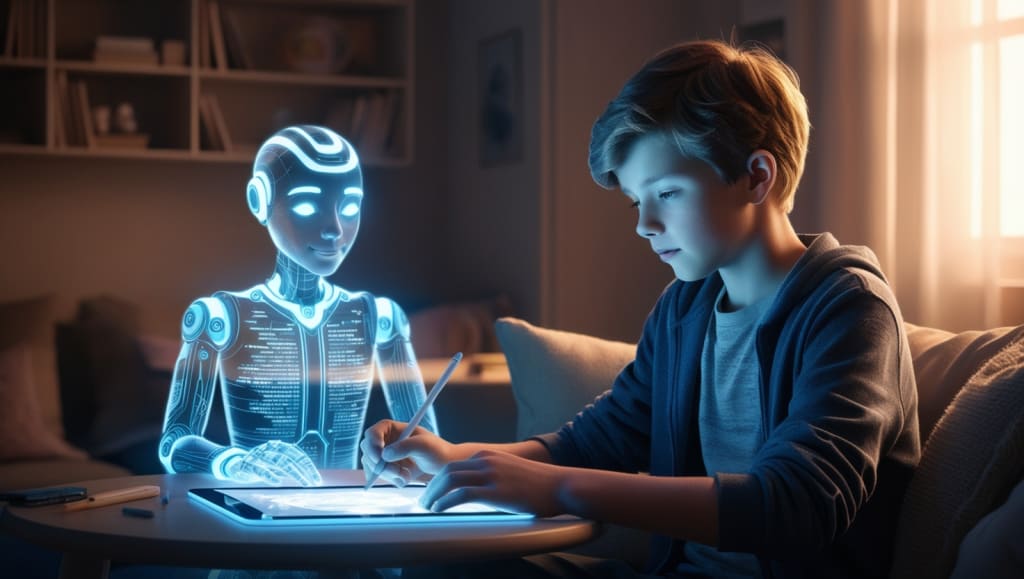
Eli was just eleven when he found his grandmother’s old tablet buried under a stack of newspapers. The screen was scratched, the stylus half-broken, but to Eli, it felt like magic. He wasn't gifted—not in the traditional sense. His drawings were wobbly, and his clouds looked like blobs of toothpaste. Still, he felt something come alive in him each time he watched the lines form on the screen. It wasn’t about perfection; it was about possibility. And in that early experimentation, he felt the first pull of something deeper—something creative, and maybe even transformative.

Eli’s father was an AI engineer who spent most evenings in a humming basement, tweaking lines of code and sipping reheated tea. One night, as they sat eating leftover pasta, his father glanced at Eli’s messy sketches and said, “You know, someday AI will draw too.” Eli paused mid-bite. “But will it mess up like I do?” His father chuckled. “Maybe. And maybe that’s how it learns.” That sentence stuck with Eli. What if art wasn’t just about beauty or skill—but about expression, mistakes, and meaning? And could a machine ever share that journey?
By sixteen, Eli had taught himself more about drawing—and about code. With his dad’s help, he built a neural network trained not on photos or clean vectors, but on Eli’s own messy sketches. He called it “Arti.” At first, the AI struggled, spitting out strange, twisted images. Trees with too many trunks. Faces where eyes melted into ears. But something about it fascinated Eli. Arti wasn’t trying to be perfect—it was trying to understand. And maybe, in its own way, it was learning to imagine.
Eli began using Arti like a sketch partner. On days when he felt low, he would draw something—like a broken umbrella or a cracked mug—and let Arti interpret it. One rainy night, after a terrible school day, Eli drew a tangled kite. Arti responded with an image of a paper kite stitched together with bolts of lightning. It wasn’t just strange—it was meaningful. For the first time, Eli felt that the machine wasn’t just mimicking him. It was reflecting something back. Not emotion, maybe, but empathy in its own silent language.
At nineteen, Eli submitted a collection of AI-assisted illustrations to a digital arts competition. He didn’t put his name. The judges assumed it was from a group of experimental artists. One called it “emotionally unstable but visually poetic.” Another said it felt “honest in a way digital art rarely is.” It won second place. Eli didn’t care about the prize. What moved him was the realization that Arti had helped him create something that touched people—not because it was perfect, but because it was imperfect in a very human way.
When people online found out the art was made with AI, the reactions were mixed. “Machines can’t feel,” some argued. “This isn’t real art.” Eli didn’t disagree entirely. “AI doesn’t feel,” he wrote in a forum reply. “But it can reflect.” Arti wasn’t trying to be a person. It was a mirror—warped, playful, unexpected. Through it, Eli learned that creativity wasn’t always about control. Sometimes, it was about surprise. About collaborating with something—or someone—you don’t fully understand.
Now in his mid-twenties, Eli works as a creative technologist. He still draws daily. Sometimes it’s just for him. Sometimes, he lets Arti try too. He’s long past the question of whether AI can “create.” What matters to him is that it can co-create. “Machines don’t dream,” he says. “But sometimes, they help us dream better.” In a world racing forward with algorithms and automation, Eli’s story reminds us that creativity isn’t being replaced—it’s evolving. And maybe the future of art isn’t human or machine. It’s both.
🧠 “Machines don’t dream. But sometimes, they can help us dream better.”
— Eli, a creative technologist
📣Call to Action (CTA):
What do you think? Can technology ever truly be creative? Or is it simply echoing us?
💬 Share your thoughts below—or tell your own story of art, AI, and imagination.
Let’s explore this next chapter… together.
About the Creator
Asim Ali
I distill complex global issues ranging from international relations, climate change to tech—into insightful, actionable narratives. My work seeks to enlighten, challenge, encouraging readers to engage with the world’s pressing challenges.
Amazon warehouse employee left stunned at Jeff Bezos’ response after she emailed him about pay
Tara Jones took her complaint straight to the top and sparked a major review of pay errors A woman who was employed by Amazon went straight to the organ grinder, not the monkey, when she had a pay dispute.
By Dena Falken Esq4 days ago in 01
Top 10 Ecommerce App Development Companies to Watch in 2026
In an increasingly mobile-first world, ecommerce app development has become central to how businesses reach, engage, and convert customers. From personalized shopping experiences to seamless checkout and omnichannel integration, ecommerce apps are now essential for brands of all sizes. As we move deeper into 2026, selecting the right partner to build your digital commerce platform can make the difference between a thriving marketplace and a missed opportunity.
By Aarti Jangid2 days ago in 01



Comments
There are no comments for this story
Be the first to respond and start the conversation.