
Ads Not Converting? Here's How To Fix That
The art and science of standing out


I think “self-service” advertising has done a lot of good, but I also know it’s done a lot of harm as well.
For the most part, it seems to have created a false sense of “expertise” in a lot of people.
Anybody can run through a 30 minute video on YouTube anymore, understanding how to upload an “ad” on Facebook, but here’s where the issue comes in:
Results come from the parts you can’t see
To give you a simple example of what I’m saying, let’s assume you’re selling “lead generation”.
This seems to be a common field that advertises on Facebook, and if you look at most ads, they typically say the same thing.
Generally speaking, it’ll be something along the lines of:
“Need leads? Reach out today!”…
Or if they’ve read Alex Hormozi’s book, it’ll be:
“100 leads or you don’t pay!”…
Two things that worked for a bit, but they don’t have the same “spunk” anymore.
Not because people don’t need leads now, but because the “messaging” is burnout.
Whenever a market sees the same thing over and over again, they eventually begin to get “ad fatigue”.
This is where they’re so tired of seeing the same message, that their brain essentially becomes numb to what you’re saying.
Might not happen overnight, but it happens, and on top of that — it causes you to blend in with the crowd.
When everybody is saying the same thing, it “commoditizes” your service, and that’s the last thing you want to happen.
Nobody pays a lot for commodities, so here’s what you want to do instead:
Positioning
When it comes to positioning, this is a marketing term that can be applied in many different ways.
If you’re creating a product, you can take a “common” solution and reposition it for a different market, such as what Birdie Brain Fuel did for Golfers:
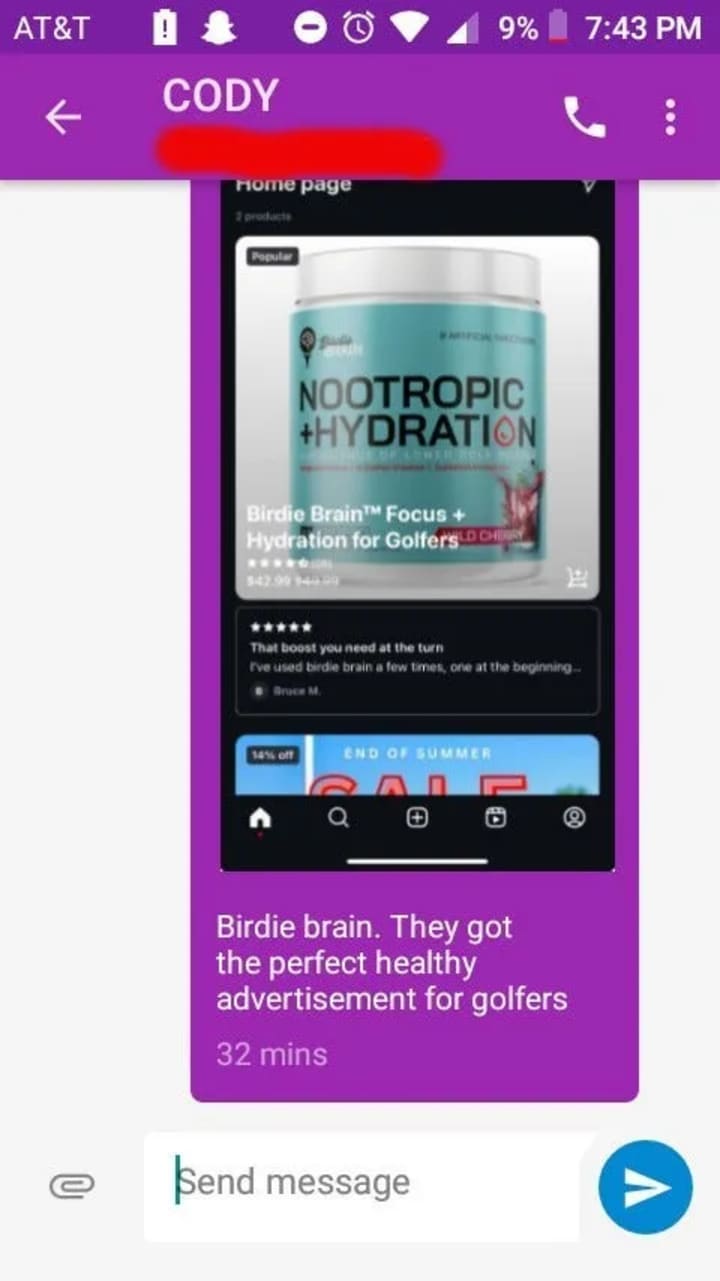
Text I received
Where it’s simply a nootropic, similar to what “Silicon Valley Entrepreneurs” use, but they “repositioned” it as a helpful tool that golfers can use to improve their score.
When you’re “sharp”, you shoot better, and that works great as most golfers would never buy this product otherwise.
It’s generally reserved for “biohackers” or “entrepreneurs”, showing how one tweak makes all the difference, but in our case — we’re just going to be looking at everything from an “ad” perspective.
No need to change your business model altogether, but we do have to take a different approach on how you “meet” prospects.
Something that’s easier said than done, but with the right approach, it can provide dramatic results.
Now, instead of being “yet another lead generation company”, you’re somebody who receives these types of messages:
Lead I received, using Advertorial
And here’s:
How to do it
For the remainder of this article, I want to take you through a simple “four-step” process.
It’s one I’ve used over the last 8 years, treating me very well along the way, and I don’t want to say it’s the “easiest” thing to pull off.
It’ll seem simple at the surface, but then you begin doing it, and realize it’s a little harder than it looks.
Think a lot of this comes from the fact of how nobody teaches us to do it this way, but with a little bit of time and effort, it does become easier.
I’ve gotten to the point where I can do this for any type of company at this stage of my career, leading me to believe it’s a skill like everything else, and here’s where we always want to start:
Step #1 — Benefits
For this part of the process, the first thing we have to do is write down EVERY benefit your product or service can provide.
This is something that’ll feel weird at first, as you don’t think there will be a long list, but if you start brainstorming — you should begin to see how that’s not the case.
To provide an example of what I’m saying, let’s look at copywriting.
I’m not talking about the “fluffy” style either, where everybody thinks they’re a copywriter, I’m talking about the legit style.
One that’s been around for decades, helping companies grow via direct-response, and the “typical” benefit people use here is:
“Increase sales”
On the surface, that’s not terrible, but the issue is how everybody does it.
As I mentioned earlier, when you use the same “messaging” as everybody else, it’s hard to stand out — so we want to go a little deeper.
Do so in a way that targets an angle few others use, so to sell this, I’d begin by writing down every other benefit I could think of.
This list would be long, but a few starting points are:
- Generate better leads
- Shorten your sales cycle
- Lower your cost per acquisition
- Etc…
Which, as you can see, isn’t necessarily items other people are talking about.
I study ads every day, and I don’t think I’ve ever seen anybody say:
“Shorten your sales cycle”…
Which is a very “unique” angle.
If I’m a business owner that has a long sales cycle, I’m going to be intrigued, probably clicking on the ad because of it.
Fair enough, that’s where we start, but then we have the second part of this process:
Step #2 — Finding the best market
With this aspect of positioning, we essentially want to make sure everything is “aligned” correctly.
If I said:
“Shorten your sales cycle”…
Then run this ad in front of struggling freelancers, the response is probably going to be “meh”.
I mean, it’d get a few people in the door, but it’s not something that’d really hit home with them specifically.
They’d be more apt to convert on:
“Struggling to find leads as a freelancer? Here’s the secret to standing out”…
Or something like that anyway, and unless you have some sort of “course”, that’s probably not going to be the best target market either.
They have $12 in their bank account, so we’d want to focus on somebody else instead, making sure we’re attracting somebody who can pay for our services.
There’s a gazillion ways to do this, which is why the process can get tricky, but for now — I’m going to assume we like B2B companies that are doing cold calls.
They’ve been doing this for many years now, having decent success along the way, but “know” they’re probably not being efficient with it either.
Their sales team is happy to get a 1% conversion ratio, which puts a limit on profits, and that allows me to “insert” a benefit that can help them.
Fair enough, that’s our target market, and then we have:
Step #3 — Customer level of awareness
I kind of gave this away in the last step, where I mentioned how our ideal prospect is:
“A B2B company that’s using cold outreach, but they know they could be more efficient”…
Because in that circumstance, it’s going to be a “problem aware” market.
They realize there’s a problem in place, just not sure how to fix it, but it’s important to have this in mind as it’ll change the “style” of your advertisement.
For example, if I said:
“Targeting B2B companies that are using cold outreach, as they think it’s the only thing that works for their market”…
Then I have an “unaware” prospect.
They don’t realize there’s a problem in place, so they won’t respond to ads in the same way.
That’s not saying it’s impossible to convert them, it’s just saying we need to take a different approach.
One that shows them the problem upfront, then inserts the solution afterwards, and that’s the “high-level” overview of this.
In most cases, it’s a blend of what I just mentioned.
Maybe we have a B2B owner that tried ads in the past, but they didn’t work, so now they think cold outreach is the only thing that’ll generate business for their industry.
There’s always “levels” to consider, which is why it’s so important to understand who we’re targeting, but we’ll keep it simple for now.
We’ll stick with our initial assumption, which was:
“B2B Owner who is using cold outreach, but knows they could be more efficient”…
Meaning our market is “problem aware”, and that brings us to the final step:
Step #4 — Messaging
Now that we:
- Understand our benefit
- Know our target market
- And have found their level of awareness…
It’s time to create the actual ad, and the final product will differ depending on what we uncovered in each step.
In some cases, you can just state your benefit, which was:
“Shorten your sales cycle”…
But in other cases, you need to come in with an “indirect” route.
One that meets them at a different angle, then brings them back to your main point, and that’s why I like uncovering the benefit first.
It’ll provide us with a “north star” for everything else, having a “big idea” of sorts, and then creating an actual ad from there.
To do this, you need to master a few “micro-skills”, including:
- Positioning
- Offer Creation
- Copywriting
- Etc…
But we’ll keep it simple now, and just create a “simplified” version for our current target market.
To do that, I always start by creating a Plain English Statement, which is a 1–2 sentence “elevator pitch” that I’ll elaborate on.
That should always be tailored to your specific market as well, meaning that for our current example, I might say:
“Cold outreach isn’t just inefficient, it also creates a longer sales cycle. When you can explain everything upfront, prospects move forward faster, here’s how to do that”…
Which, as you can see, is a great starting point.
Now, all I have to do is “elaborate”, and I’m not going to create a full-blown ad for this article.
That takes me weeks to do, but as a “rough draft”, I might use the headline of:
“Pre-suasion Assets Lower Your Sales Cycle To 30 Days Or Less (Here’s How)”…
As they’re problem aware, so that’d work.
Don’t need to get too fancy, they’re already aware there’s an issue in place, but there’s also a few “glimpses” of advanced logic in there as well.
For starters, they’ve never heard of a “pre-suasion” asset, so we have a unique mechanism — and I’m guessing they never thought of “long sales cycles” either.
If anything, that’ll allow us to “pile on” their current problem, giving us our “hooks” — then using the remainder of our ad to really drive this point home.
I’d do that with long-form copy up top, saying something along the lines of:
“Let’s face it, when you use cold outreach, the hardest part is explaining how your service can benefit somebody.
Nobody likes receiving cold calls, so their guard is already up, and they probably won’t spend a lot of time listening to your pitch.
The only thing they’re thinking about is:
“How do I get off this call?”…
Which sucks, as you have an offer that can really benefit them.
Maybe that’s adding more money to their business, or maybe it’s improving their life in some other way, the options are endless — but it provides a weird conundrum nonetheless.
We know that if they’d just hear our pitch, they’d move forward, here’s my favorite way to address this issue:
Pre-Suasion Assets”…
Etc, you get the hint.
The ad itself would be a gazillion times better, but the logic remains the same.
In the beginning stages, the hardest part of advertising is simply standing out.
When you say the same thing as everybody else, such as:
“Generate more leads”…
You’ll get less clicks, as there’s a lot of “ad fatigue”.
The market is tired of hearing that, so to even get your foot in the door, you have to be different.
Not saying you need to be a clown either, creating an ad that says:
But instead, you need to say something they’ve never heard before.
Doing so with a benefit that’s “unique”, as your competition has never thought about this, then after reaching that point — you need to elaborate on this benefit.
If I just said:
“Shorten your sales cycle. Sign-up for a free phone call to learn more”…
Then conversions will be lower.
Nobody likes jumping on calls, especially if they don’t fully understand what’s going on, but that changes when you explain everything upfront.
Now, they read what you have to say and take actions similar to this:

Lead I generated
Which is the holy grail of marketing.
Pretty much “salesmanship in print”, handling 99% of the process before they ever jump on a call, and that takes us to:
The recap
Long story short, even though I just gave an example that relates to “lead generation”, this is something that applies to any type of business.
I’ve used this process to sell:
- MealKits (think HelloFresh)
- Courses
- Consulting
- All types of products
- All sorts of services…
The whole works, and it applies to everybody, as all human psychology is the same.
We only move forward with something that benefits us, so that’s where you always want to start, but the downside is how we can’t say the same thing as everybody else either.
If you do, then you’ll kill results because of “ad fatigue”, so you need to take a different route — getting your foot in the door that way.
After this is accomplished, you’ll want to spend time explaining “how” you can get this benefit, because remember — it’s probably not something they’re “too” familiar with.
Sure, they’ll know what “sales cycles” are, but they want a general overview of how you can actually help them shorten it.
From there, assuming everything makes sense, they’ll have no other choice but to take the next step — as everybody wants something that can help them.
This is obviously assuming you have everything else lined up correctly, including:
- Target Market (that has money)
- Ad targeting
- Etc…
But if that’s the case, success is a natural byproduct, as that’s how “sales” work.
Robby Blanchard helps companies and marketers grow their bottom line with automated salesmanship. Learn more at joinchero.com
Want more marketing tips and tricks? Subscribe to the Better Marketing newsletter The Marketing Memo here.
About the Creator
Clark Rollings
Stock market analyst and athlete, writing about investing, self-improvement, and more.
Keep reading
More stories from Clark Rollings and writers in 01 and other communities.
How to Maintain Healthy Skin Between Home Salon Appointments
In a rapidly evolving life in Ras Al Khaimah during the year 2026, looking good is a key part of your social status. We have moved away from the old way of driving to busy shops because we value our time more than ever before. This is why people are always searching for the best home salon services near me in Ras Al Khaimah to fix their schedules. However, a professional visit is only one part of the total plan for your skin health. You must take care of your skin between these visits to ensure you get the best return on your money. This post provides the best daily plan to keep your skin looking sharp and healthy in the unique weather of the Northern Emirates.
By Julia Chinga day ago in 01



Comments
There are no comments for this story
Be the first to respond and start the conversation.